




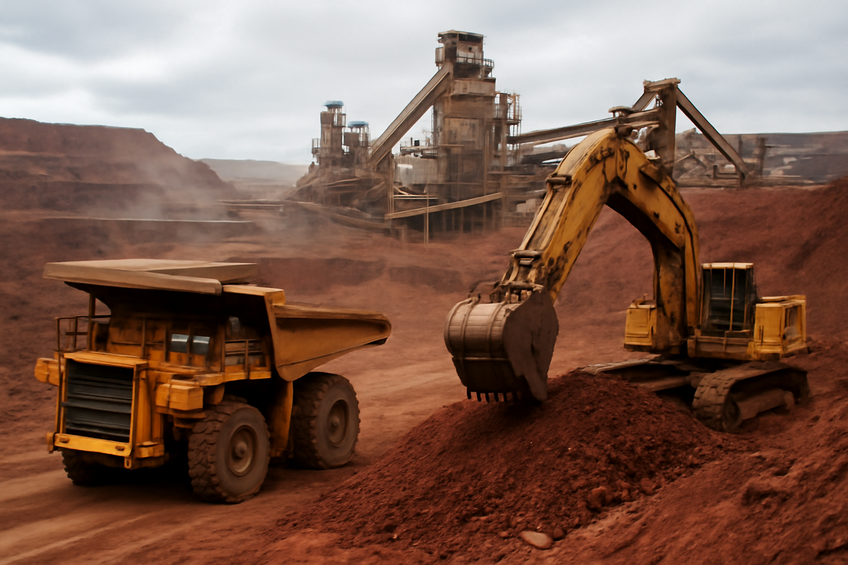
Mid-Tier Miners Caught in the Squeeze
Iron ore price volatility has emerged as one of the defining operational challenges for mid-tier producers, whose cost structures leave them with far less buffer than the major diversified miners when benchmark prices swing sharply. Unlike the giants of the Pilbara, mid-tier operations typically cannot absorb sustained price weakness through economies of scale or offset losses with revenue from other commodities, making margin management a constant and high-stakes discipline.
The iron ore market has experienced pronounced price swings in recent periods, driven by shifting demand signals from China’s steel sector, policy adjustments affecting construction and infrastructure spending, and fluctuating supply from major producing regions. For mid-tier producers operating in that environment, the difference between a profitable quarter and a loss-making one can hinge on relatively modest moves in the benchmark price.
Why Mid-Tier Producers Face Disproportionate Pressure
The structural disadvantage facing smaller and mid-scale iron ore operations is straightforward: their all-in sustaining costs sit meaningfully higher than those of the largest low-strip, high-volume producers. When prices contract, the margin erosion hits mid-tier operations first and hardest, while the majors continue generating cash at price points that would push a mid-tier producer into negative free cash flow territory.
Several compounding factors intensify this exposure:
- Grade and product mix: Mid-tier producers are more likely to sell lower-grade fines, which attract a price discount to the standard benchmark, amplifying effective revenue declines during soft markets.
- Freight cost sensitivity: Operations located at greater distance from Chinese ports carry higher freight costs, which are largely fixed regardless of the spot price received.
- Limited hedging capacity: Smaller balance sheets restrict access to sophisticated hedging instruments, leaving revenue more exposed to real-time price fluctuations.
- Capital expenditure obligations: Ongoing mine development, tailings management, and infrastructure investment cannot simply be paused during downturns without longer-term operational consequences.
- Financing costs: Mid-tier producers with project debt face fixed repayment schedules regardless of commodity revenue, tightening cash flow precisely when it is most constrained.
Demand-Side Uncertainty and the China Factor
China’s steel industry remains the dominant pricing force in the seaborne iron ore market, and the signals it is currently sending are complex. The transition away from debt-heavy property development toward infrastructure and manufacturing investment has reshaped the composition of steel demand, affecting which grades and product specifications command the strongest premiums. Mid-tier producers whose ore specifications were well-aligned with older demand patterns may find their product competitiveness has shifted.
Steel mill profitability in China has also come under pressure at various points in the current cycle, prompting mills to seek lower-cost feedstocks or reduce production rates. When mills pull back, spot demand softens quickly, and the producers least able to absorb price deterioration — the mid-tier operators — bear the consequences most directly.
Scrap Steel and the Long-Term Grade Premium Debate
A longer-running structural question is whether rising electric arc furnace adoption in China will gradually erode demand for lower-grade iron ore fines while sustaining or increasing demand for higher-grade pellets and lump. If that transition accelerates, mid-tier producers with average or below-average ore quality face both near-term price volatility and a longer-term product repositioning challenge. Those able to supply higher-grade material, or invest in beneficiation, will be better positioned to defend margins as the market structure evolves.
Operational and Strategic Responses
Mid-tier producers are not passive in the face of margin pressure. The most effective responses tend to cluster around cost discipline, capital allocation prioritisation, and selective production flexibility — adjusting output from higher-cost mining areas when price conditions deteriorate.
Cost reduction efforts at the operational level typically focus on:
- Optimising drill-and-blast and load-and-haul cycles to reduce unit mining costs
- Renegotiating contractor and supply agreements during market downturns when leverage shifts to buyers
- Improving processing recovery rates to extract more saleable product from the same ore volume
- Deferring non-essential capital expenditure without compromising mine safety or regulatory compliance
On the strategic side, some mid-tier producers are pursuing partnerships, offtake agreements, or partial asset sales to shore up balance sheets and reduce near-term financial risk. Others are investing in ore blending infrastructure to improve delivered product quality, directly targeting the grade premium that higher-specification material commands in the current market.
The Role of Currency and Input Cost Movements
Currency dynamics offer mid-tier producers in Australia, Canada, and other non-US-dollar jurisdictions a partial natural hedge: when iron ore prices fall, commodity-linked currencies often weaken against the US dollar, partially offsetting the revenue decline in local currency terms. Similarly, diesel, explosives, and steel consumables prices sometimes ease alongside broader commodity softness, providing modest cost relief. These mechanisms do not eliminate margin pressure, but they can meaningfully soften its impact for well-positioned operators.
The outlook for mid-tier iron ore producers will depend heavily on whether Chinese steel demand stabilises at levels that support benchmark prices in ranges where diversified cost structures remain viable. Producers that use this period to harden their cost base, improve product quality, and reduce balance sheet vulnerability will be better placed to capitalise when the pricing cycle turns — as it historically does. Those that delay structural adjustments risk finding the window to adapt has narrowed considerably.


