





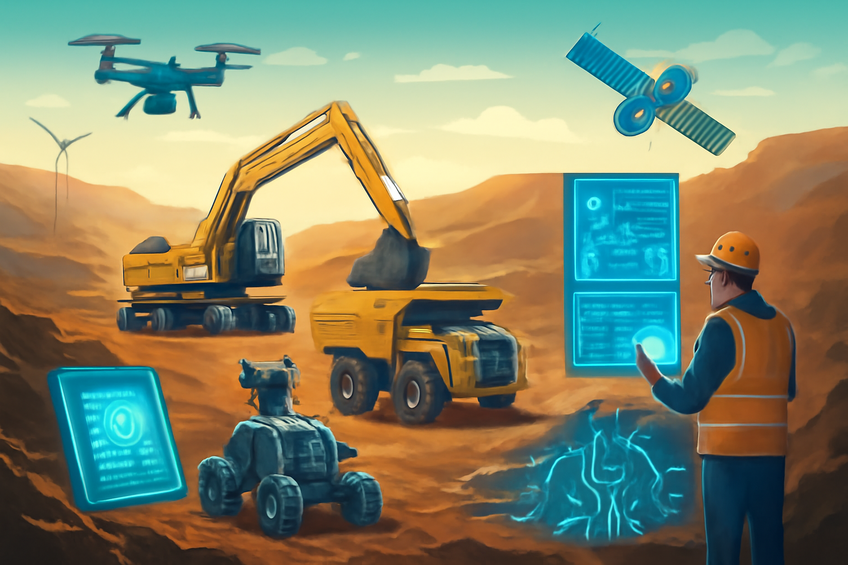
The mining industry is undergoing a massive transformation. As global demand for critical minerals and metals continues to surge, traditional mining methods are being replaced by cutting-edge innovations that promise safer, cleaner, and more efficient operations. From artificial intelligence to autonomous equipment, the future of mining is being written right now. Here are the top 10 breakthrough technologies reshaping the mining industry in 2025.
1. Autonomous Mining Equipment and Vehicles
Self-driving trucks, loaders, and drilling machines are no longer science fiction. In 2025, autonomous mining vehicles are operating across major mine sites in Australia, Canada, and Chile. Companies like Caterpillar, Komatsu, and Rio Tinto have deployed fleets of autonomous haul trucks that operate 24/7 without human drivers, significantly reducing operational costs and improving safety.
These vehicles use a combination of LiDAR sensors, GPS technology, and machine learning algorithms to navigate complex mine environments. The result is fewer accidents, lower fuel consumption, and productivity increases of up to 20% compared to human-operated equipment.
Key Benefits of Autonomous Mining Vehicles
- Reduced workplace injuries and fatalities
- Lower operational costs through optimized fuel usage
- Continuous 24-hour operation without shift breaks
- Real-time data collection and performance monitoring
2. Artificial Intelligence and Machine Learning in Mineral Exploration
AI-powered exploration tools are transforming how mining companies identify and assess new deposits. In 2025, machine learning models are analyzing vast geological datasets, satellite imagery, and historical drilling data to pinpoint high-value mineral deposits with unprecedented accuracy.
Platforms like KoBold Metals and Goldspot Discoveries are using AI to reduce the time and cost of exploration by up to 70%. These systems can predict the location of lithium, copper, nickel, and cobalt deposits — minerals critical for the global energy transition — far more efficiently than traditional methods.
How AI Is Improving Mineral Exploration
- Faster identification of viable deposit locations
- Reduced exploration costs and environmental footprint
- Integration of geophysical, geochemical, and remote sensing data
- Improved accuracy in resource estimation and reserve classification
3. Electric and Hydrogen-Powered Mining Equipment
The push toward decarbonization is driving massive adoption of electric and hydrogen-powered equipment in underground and surface mining operations. In 2025, battery-electric vehicles (BEVs) are becoming standard in underground mines where diesel emissions pose serious health risks to workers.
Companies like Epiroc, Sandvik, and Boliden are leading the charge with electric drill rigs, loaders, and haulers that produce zero direct emissions. Meanwhile, hydrogen fuel cell technology is being piloted for surface haul trucks, offering longer range and faster refueling compared to battery-only solutions.
Environmental and Operational Impact
- Significant reduction in carbon emissions and ventilation costs
- Lower long-term energy costs compared to diesel
- Improved air quality in underground mining environments
- Alignment with global ESG and sustainability targets
4. Digital Twins and Advanced Mine Simulation
A digital twin is a virtual replica of a physical mining operation, updated in real time using sensor data from equipment, geology, and infrastructure. In 2025, digital twin technology is being widely adopted to optimize mine planning, predict equipment failures, and simulate the impact of operational decisions before they are implemented.
Mining giants like BHP and Anglo American are using digital twins to model entire mine sites, allowing engineers to test different scenarios virtually and select the most efficient and safe course of action. This reduces costly mistakes and dramatically shortens the planning cycle.
Applications of Digital Twins in Mining
- Real-time mine planning and production optimization
- Predictive maintenance of critical equipment
- Safety simulations and emergency response planning
- Environmental impact modeling and water management
5. Robotics and Remote-Controlled Operations
Robotic systems are taking over the most dangerous and repetitive tasks in mining. From robotic rock bolting in underground mines to remotely operated drilling rigs, mining robotics in 2025 are enhancing both safety and productivity in ways that were unimaginable just a decade ago.
Remote operation centers, sometimes located thousands of kilometers from the actual mine site, allow operators to control equipment via high-speed internet connections. This approach keeps workers away from hazardous environments while maintaining full operational control.
Types of Robotic Systems Used in Mining
- Automated rock bolting and ground support robots
- Robotic sampling and geological mapping systems
- Remote-controlled explosive loading equipment
- Inspection drones for structural and environmental monitoring
6. Drone Technology and Aerial Surveying
Drones have become indispensable tools in modern mining operations. In 2025, advanced unmanned aerial vehicles (UAVs) equipped with multispectral cameras, LiDAR sensors, and hyperspectral imaging systems are being used for geological mapping, stockpile measurement, environmental monitoring, and safety inspections.
What used to take survey teams days or weeks can now be accomplished in a matter of hours with drones. The data collected is processed using photogrammetry software to create highly accurate 3D models of mine sites, improving planning and operational efficiency.
Mining Applications of Drone Technology
- Accurate stockpile volume measurements
- High-resolution geological and topographic mapping
- Environmental compliance and vegetation monitoring
- Inspection of tailings dams and infrastructure
7. Internet of Things (IoT) and Smart Sensor Networks
The Internet of Things (IoT) is connecting every piece of equipment, sensor, and system within a mining operation into a single integrated network. In 2025, smart sensors embedded in machinery, rock faces, and infrastructure are transmitting real-time data on temperature, vibration, gas levels, structural integrity, and production metrics.
This connected ecosystem enables mine operators to make faster, data-driven decisions. Predictive analytics powered by IoT data can identify equipment failures before they occur, reducing costly unplanned downtime and improving overall mine throughput.
Benefits of IoT in Mining Operations
- Real-time equipment health and performance monitoring
- Early warning systems for geological hazards
- Optimized energy consumption across the operation
- Enhanced worker safety through wearable IoT devices
8. Advanced Ore Sorting and Processing Technology
One of the most exciting developments in mining is the advancement of sensor-based ore sorting technology. Using X-ray transmission, near-infrared sensors, and laser-induced breakdown spectroscopy (LIBS), modern ore sorting systems can analyze and separate ore from waste rock in real time on conveyor belts, before the material even reaches the processing plant.
This technology dramatically reduces energy consumption, water usage, and processing costs by ensuring only valuable material enters the processing circuit. In 2025, ore sorting is being adopted at scale across gold, copper, diamond, and lithium operations worldwide.
Why Ore Sorting Is a Game Changer
- Reduces energy and water consumption in processing plants
- Increases overall ore grade and recovery rates
- Minimizes the volume of tailings generated
- Enables economic processing of lower-grade deposits
9. Blockchain Technology for Supply Chain Transparency
As consumers and regulators demand greater accountability in mineral supply chains, blockchain technology is emerging as a critical tool for the mining industry. In 2025, blockchain platforms are being used to track minerals from the point of extraction through refining, manufacturing, and final product delivery, creating an immutable and transparent record at every step.
This is particularly important for conflict minerals such as cobalt and coltan, where ethical sourcing has become a major concern for technology companies and automotive manufacturers. Blockchain ensures that claims of responsible sourcing can be independently verified.
Blockchain Use Cases in Mining
- End-to-end traceability of critical minerals
- Verification of ethical and sustainable sourcing claims
- Streamlined regulatory reporting and compliance
- Reduction of fraud in commodity trading and certification
10. Deep Sea and Space Mining Technologies
Perhaps the most futuristic of all mining technologies in 2025 are the advances being made in deep sea mining and asteroid mining. As terrestrial mineral reserves become increasingly depleted and difficult to access, companies and governments are looking beyond land-based operations to unlock vast new resources.
Deep sea mining targets polymetallic nodules on the ocean floor that are rich in nickel, cobalt, copper, and manganese. Companies like The Metals Company and Nautilus Minerals are developing robotic systems capable of operating at depths of over 4,000 meters. Meanwhile, space agencies and private companies like AstroForge are developing technologies to extract platinum-group metals from near-Earth asteroids.
Challenges and Opportunities of Frontier Mining
- Rich mineral deposits far exceeding terrestrial reserves
- Significant engineering and environmental challenges remain
- Regulatory frameworks still being developed internationally
- Potential to supply critical minerals for the clean energy transition
The Future of Mining: Smarter, Safer, and More Sustainable
The technologies reshaping the mining industry in 2025 share a common thread: they are making mining smarter, safer, and more sustainable. From AI-driven exploration to autonomous fleets and blockchain-enabled supply chains, the industry is evolving at an unprecedented pace to meet the growing global demand for critical minerals while reducing its environmental and social footprint.
Mining companies that embrace these breakthrough technologies will be well-positioned to thrive in an increasingly competitive and regulation-intensive landscape. Those that fail to adapt risk being left behind as the industry enters a new era of digital transformation and sustainable resource extraction.
Frequently Asked Questions About Mining Technologies in 2025
What is the biggest technology trend in mining in 2025?
The biggest technology trends in mining in 2025 include autonomous vehicles, AI-powered exploration, and electrification of mining equipment. These three areas are seeing the highest levels of investment and deployment across major mining companies worldwide.
How is AI being used in the mining industry?
AI is being used in mining for mineral exploration, predictive maintenance, production optimization, ore grade prediction, and safety monitoring. Machine learning models analyze large datasets to uncover insights that improve efficiency and reduce costs across the entire mining value chain.
Why is sustainable mining technology important?
Sustainable mining technology is important because it reduces the environmental impact of resource extraction, helps companies meet increasingly strict ESG regulations, and ensures long-term social license to operate. Technologies like electric equipment, water recycling systems, and advanced ore sorting all contribute to more sustainable mining operations.
What critical minerals are driving mining technology investment?
Lithium, cobalt, nickel, copper, and rare earth elements are the primary critical minerals driving technology investment in mining. These minerals are essential for electric vehicle batteries, renewable energy systems, and advanced electronics, making their efficient and ethical extraction a global priority.


