




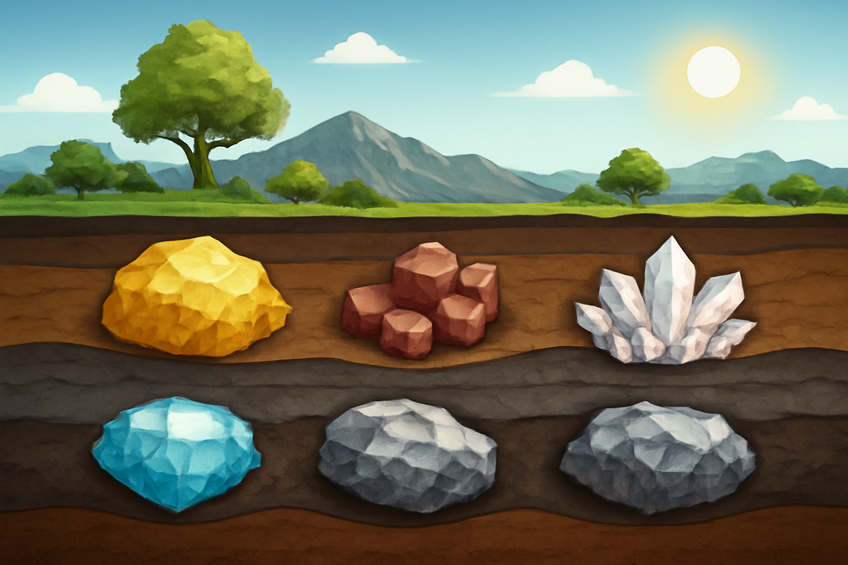
Throughout human history, the discovery of mineral deposits has shaped civilizations, sparked wars, built empires, and fueled the global economy. Some of these deposits are so extraordinarily rich that they continue to define entire nations’ economies to this day. From glittering gold veins buried deep beneath African soil to copper-rich mountains in South America, these geological treasures represent nature’s most spectacular gifts to humanity. In this post, we explore the top 10 richest mineral deposits ever discovered on Earth, examining their scale, value, and lasting impact on the world.
1. Witwatersrand Gold Basin – South Africa
Widely regarded as the richest gold deposit ever discovered, the Witwatersrand Basin in South Africa has produced more than 50,000 tonnes of gold since its discovery in 1886. Located in the Gauteng province, this massive underground reef stretches across hundreds of kilometers and sits thousands of meters below the surface. The discovery triggered the famous Rand Gold Rush and ultimately led to the founding of Johannesburg. Today, South Africa still mines gold from this legendary basin, though output has declined significantly from its peak in the 1970s. The Witwatersrand alone accounts for nearly 40% of all the gold ever mined in human history, making it an unparalleled geological wonder.
2. Bushveld Igneous Complex – South Africa
The Bushveld Igneous Complex (BIC) is the world’s largest known layered igneous intrusion and is home to the planet’s most significant deposits of platinum group metals (PGMs), including platinum, palladium, rhodium, and chrome. Spanning over 65,000 square kilometers in South Africa’s Limpopo province, this complex holds an estimated 80% of the world’s known platinum reserves. The BIC also contains vast amounts of chromite, vanadium, and iron ore. Its economic value runs into the trillions of dollars, and mining operations in the region support millions of livelihoods. This single geological structure makes South Africa the undisputed leader in global platinum production.
3. Escondida Copper Mine – Chile
Located high in the Atacama Desert of northern Chile at an altitude of over 3,000 meters, the Escondida Mine is the largest copper producer in the world. Discovered in 1981 and opened in 1990, this open-pit mine has consistently produced over 1 million tonnes of copper per year, accounting for approximately 5% of global copper supply. Owned by a consortium led by BHP, the deposit contains billions of tonnes of ore with significant grades of copper sulphide and oxide. Copper from Escondida powers electrical infrastructure, electronics manufacturing, and renewable energy systems worldwide. The mine’s total value is estimated at well over $200 billion.
4. Olympic Dam – Australia
The Olympic Dam deposit in South Australia is one of the most remarkable mineral discoveries in history, containing the world’s largest known uranium deposit while also holding significant reserves of copper, gold, and silver. Discovered in 1975 by Western Mining Corporation, this massive underground mine is operated by BHP and produces substantial quantities of copper cathode, uranium oxide, gold, and silver annually. The deposit contains an estimated 10 billion tonnes of ore, making it extraordinary in both scale and mineral diversity. Olympic Dam’s uranium resources are particularly significant given the growing global interest in nuclear energy as a clean power source.
5. Grasberg Mine – Indonesia
Hidden within the Sudirman mountain range in Papua, Indonesia, the Grasberg Mine is one of the most remarkable mineral deposits ever found. It holds the world’s largest gold reserve and the second largest copper deposit on the planet. Discovered in 1936 by Dutch geologist Jean Jacques Dozy and developed by Freeport-McMoRan, this high-altitude mine sits at nearly 4,300 meters above sea level. The deposit contains an estimated 67 million ounces of gold and 30 billion pounds of copper. Despite its remote and challenging location, Grasberg has been one of the most profitable mining operations in the world and has generated hundreds of billions of dollars in revenue over its lifetime.
6. Sudbury Basin – Canada
The Sudbury Basin in Ontario, Canada, is one of the most unique mineral deposits on Earth because it was formed by a massive meteorite impact approximately 1.85 billion years ago. This ancient cosmic collision created a massive basin rich in nickel, copper, cobalt, and platinum group metals. The Sudbury Basin holds one of the world’s largest nickel deposits, with total resources estimated at several billion tonnes of ore. Major mining companies including Vale and Glencore operate extensively in the region. The basin has produced more than 10 million tonnes of nickel over its mining history and remains one of Canada’s most economically important geological features.
7. Bayan Obo Mining District – China
Located in Inner Mongolia, China, the Bayan Obo Mining District is home to the world’s largest rare earth element (REE) deposit, along with significant reserves of iron ore and niobium. Discovered in 1927, this massive deposit has become strategically critical in the modern era as rare earth elements are essential for manufacturing electric vehicle motors, smartphones, wind turbines, and military technology. China’s dominance over Bayan Obo gives it extraordinary leverage over global supply chains for these critical minerals. The deposit contains an estimated 800 million tonnes of ore with remarkable concentrations of cerium, lanthanum, neodymium, and dozens of other rare earth elements.
8. Carlin Trend – Nevada, USA
The Carlin Trend in northeastern Nevada is one of the most significant gold discoveries in North American history. Spanning approximately 90 kilometers in length, this geological corridor contains numerous overlapping gold deposits that have collectively produced over 80 million ounces of gold since their discovery in the 1960s. The gold here is unique in that it exists as microscopic particles disseminated throughout the rock, known as invisible gold or Carlin-type deposits. Major producers like Nevada Gold Mines (a joint venture between Barrick Gold and Newmont) operate extensively along the trend. The Carlin Trend has made Nevada the third largest gold-producing jurisdiction in the world, behind only South Africa and Australia.
9. Cerro Rico – Bolivia
Known as the “Mountain That Eats Men,” Cerro Rico in Potosí, Bolivia, is one of the most historically significant mineral deposits ever discovered. When Spanish conquistadors found this mountain in 1545, it contained one of the richest silver deposits in human history. Over the following three centuries, Cerro Rico produced an estimated 45,000 tonnes of silver, effectively financing the Spanish Empire and reshaping the global economy. The wealth extracted here is believed to have directly funded European colonialism and trade routes around the world. Today, Cerro Rico is still mined by thousands of cooperatives, though it now produces primarily tin, zinc, and lead as its silver reserves have been largely depleted. The mountain is a UNESCO World Heritage Site.
10. Norilsk Mining District – Russia
Located far above the Arctic Circle in Siberia, the Norilsk Mining District is one of the richest and most important mineral deposits in the world. This extraordinary complex holds the world’s largest known nickel-copper-palladium deposit, with reserves estimated in the billions of tonnes. Norilsk Nickel, the company that operates in this region, produces approximately 15% of the world’s nickel, 40% of its palladium, and significant quantities of platinum, cobalt, and copper. The deposit was first developed under Soviet rule using forced labor, and the city of Norilsk was built entirely to support the mining operations. Despite its remote location and extreme climate, Norilsk remains one of the most economically valuable mining districts on Earth, with a total resource value estimated in the hundreds of billions of dollars.
What Makes a Mineral Deposit Truly Rich?
Not all mineral deposits are created equal. The value of a mineral deposit depends on several key factors that geologists and mining companies evaluate carefully before investing billions in extraction operations.
Grade and Concentration
The grade of a deposit refers to the concentration of the valuable mineral within the surrounding rock. Higher grades mean more valuable minerals per tonne of ore mined, making extraction far more economical. However, even low-grade deposits can be highly valuable if they are large enough.
Size and Total Resource Volume
The sheer volume of ore is equally important. Some of the world’s most valuable deposits, like Olympic Dam, have relatively modest grades but contain such vast quantities of material that their total resource value is immense. The bigger the deposit, the longer and more sustainably it can be mined.
Accessibility and Location
Even the richest mineral deposit in the world is only valuable if it can be economically accessed. Factors such as depth, terrain, climate, and proximity to infrastructure all significantly affect whether a deposit can be profitably mined. Many rich deposits remain undeveloped simply because the cost of extraction would exceed the value of the minerals recovered.
Commodity Demand and Market Value
The value of a mineral deposit is ultimately determined by global commodity markets. As demand for metals like lithium, cobalt, and rare earth elements surges due to the green energy transition and technological revolution, previously overlooked deposits are suddenly becoming extraordinarily valuable.
The Future of Mineral Discovery
Despite centuries of mining and exploration, scientists and geologists believe that many of Earth’s richest mineral deposits are yet to be discovered. Deep-sea mineral nodules, Arctic deposits beneath melting ice caps, and deep underground formations represent exciting frontiers for future mineral exploration. Advanced technologies such as satellite imaging, artificial intelligence, and deep-drilling techniques are revolutionizing the way we search for and evaluate mineral deposits.
Moreover, as the world accelerates its transition toward renewable energy and electric vehicles, the demand for minerals like lithium, cobalt, nickel, and rare earth elements will only intensify. This is driving unprecedented investment in mineral exploration worldwide, increasing the likelihood of new, significant discoveries in the coming decades.
Conclusion
The richest mineral deposits ever discovered on Earth are not just geological curiosities — they are the foundations upon which modern civilization has been built. From the gold of the Witwatersrand that powered South Africa’s economy to the rare earth elements of Bayan Obo that enable today’s cutting-edge technology, these deposits have shaped history, driven economic development, and continue to influence global geopolitics. As our demand for minerals grows in the age of clean energy and advanced technology, the discovery and responsible management of these extraordinary natural resources will remain one of humanity’s most critical challenges and greatest opportunities.


