





By Jamie Hyland, MiningIR
Krait Critical Minerals Corp. CEO Oscar Mendoza joined Stock Investor Daily for a one-on-one video interview about the company’s Ontario gold project, its move into U.S. antimony and the approach he takes to evaluating acquisitions.
Krait (CSE: KRIT | FSE: U0S) began with the Goldbar Spider Lake Project in Ontario’s Thunder Bay Mining Division. The 3,636-hectare property lies in the Western Schreiber–Hemlo Greenstone Belt, approximately 30 kilometres west-northwest of Marathon. Krait holds an option to earn a 100% interest, subject to a 3% net smelter return royalty. The property has year-round highway access and nearby rail and power infrastructure.
Watch Below: Oscar Mendoza’s one-on-one interview with Stock Investor Daily
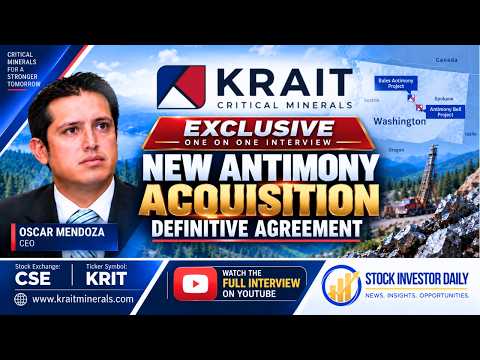
In the interview, Mendoza described how a prospector first brought the Ontario opportunity to him and why the property became Krait’s flagship asset. He pointed to the exploration work completed to date while discussing the geological case for further evaluation. Goldbar Spider Lake remains an exploration-stage property: it has no mineral resource or reserve defined under NI 43-101.
The conversation then turned to antimony. Since the interview’s discussion of Krait’s acquisition agreement, the company has completed its acquisition of Nevada Hills Antimony LLC. Through that transaction, Krait added interests connected to the Bales Antimony Project and other assets in Washington State. Bales has a record of historic workings and reported antimony mineralization, which the company intends to assess through further field and technical work. Historic information provides a starting point for exploration; it does not establish a current mineral resource or commercial viability.
Mendoza’s explanation of the antimony opportunity extended beyond geology. Drawing on his background in metals and mining finance, he discussed the importance of processing capacity, transportation and access to end markets when assessing critical mineral projects. Those considerations help explain why Krait is looking at North American opportunities as part of a broader portfolio strategy.
He also addressed how he wants to build the company. Mendoza said prospective acquisitions must meet Krait’s criteria and make sense for its shareholders. He emphasized careful evaluation of transaction terms and the share structure, describing a measured approach to adding projects. His comments set out management’s intentions; the results will depend on exploration, financing and execution.
For investors following Krait, the interview offers a direct account of how Mendoza connects the Ontario gold property with the company’s U.S. antimony interests. The next evidence will come from the work itself: field results, technical interpretation and Krait’s decisions about where to commit capital.
Disclosure: Krait has engaged MiningIR for paid media and communications services, including editorial and video content. This article is informational and is not investment advice.


