





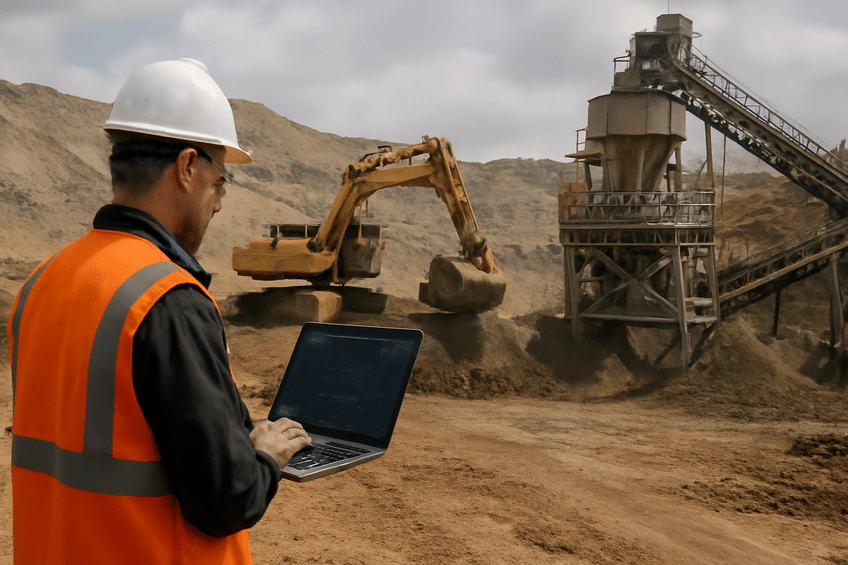
Predictive maintenance software is reshaping how open-pit mining operations manage crusher availability, shifting the industry away from reactive repair cycles toward condition-based intervention. As crushers represent one of the highest-value and highest-consequence pieces of equipment on any open-pit site, the ability to anticipate mechanical failure before it occurs has moved from a competitive advantage to an operational necessity.
The Crushing Cost of Unplanned Downtime
Open-pit crushers — whether primary gyratory units at the pit rim or secondary and tertiary cone crushers further down the circuit — sit at a critical chokepoint in the comminution chain. When a crusher goes down unexpectedly, the impact cascades immediately: haul trucks queue and idle, downstream mills starve for feed, and throughput targets collapse. The financial exposure from a single unplanned stoppage lasting more than a few hours can be substantial, particularly at high-tonnage operations where crusher availability is directly tied to mill utilization rates.
Historically, maintenance teams relied on fixed time-based schedules or ran equipment until failure presented itself — both approaches carry significant inefficiencies. Time-based maintenance often results in replacing components that still have usable life, while run-to-failure strategies expose operations to catastrophic damage and extended downtime. Predictive maintenance software addresses both failure modes by using real-time and historical data to identify degradation before it becomes a stoppage event.
How Predictive Maintenance Software Works in Crusher Applications
Modern predictive maintenance platforms aggregate data from multiple sensor types installed across crusher assemblies. The analytical logic then identifies deviation patterns that precede known failure modes, issuing alerts and work orders before the equipment reaches a critical threshold.
Key Sensor Inputs and Data Sources
- Vibration analysis: Accelerometers mounted on crusher frames, eccentrics, and drive assemblies detect abnormal frequency signatures associated with bearing wear, imbalance, and liner deterioration.
- Thermal imaging and temperature monitoring: Elevated temperatures in lubrication circuits, hydraulic systems, and motor windings often precede mechanical failure by hours or days.
- Oil condition monitoring: Particle counters and viscosity sensors in lubrication systems identify metallic wear debris and contamination, indicating internal component degradation without requiring physical inspection.
- Power draw and load monitoring: Deviations in motor current and torque signatures can signal liner wear progression, feed segregation issues, or mechanical resistance in the drive train.
- Acoustic emission sensors: High-frequency acoustic monitoring can detect micro-fractures and surface fatigue in crusher mantles and concaves earlier than conventional vibration analysis.
Machine Learning and Pattern Recognition
The analytical engine behind leading predictive maintenance platforms has evolved well beyond simple threshold alarms. Machine learning models trained on equipment-specific historical data can distinguish between normal operational variation and genuinely anomalous signatures, reducing the false-positive rates that undermined earlier generation condition monitoring systems. As models accumulate more operational data from a specific crusher, their predictive accuracy improves — creating a self-reinforcing value proposition for long-running operations.
Integration with mine planning and scheduling systems allows maintenance windows to be slotted into planned production gaps rather than imposed by emergency, preserving throughput targets while still addressing identified risks. Some platforms now generate automated work order recommendations tied directly to the maintenance management system, reducing the manual interpretation burden on site engineers.
Operational and Commercial Outcomes
Operations that have deployed predictive maintenance software across their crusher circuits consistently report measurable improvements in several areas. While specific outcomes vary by equipment type, ore characteristics, and operational context, the directional benefits are well established across the industry.
- Reduction in mean time between failures as high-risk components are replaced at optimal intervals rather than at failure.
- Lower maintenance spend over time as condition-based part replacement reduces over-servicing and emergency procurement premiums.
- Extended crusher component life, particularly in mantles, concaves, and eccentric assemblies, where liner management is refined through wear-rate modelling.
- Improved safety outcomes as technicians are less frequently exposed to emergency repair conditions under time pressure.
- Better contractor planning, as maintenance teams can schedule specialist support in advance rather than mobilizing emergency crews.
The commercial case is particularly compelling for large open-pit operations processing high-tonnage, lower-grade ore, where marginal improvements in crusher availability translate directly into meaningful production gains at the mill. For these sites, the return on software investment is typically realized within the first one to two years of deployment.
Implementation Considerations for Mining Operations
Deploying predictive maintenance software is not a plug-and-play exercise. Sensor retrofit on existing crusher installations requires careful engineering to avoid interfering with structural integrity or introducing new failure points. Data infrastructure — including edge computing capacity and reliable network connectivity at the pit — must be robust enough to handle continuous high-frequency data streams without latency that would undermine real-time alerting.
Change management is equally important. Maintenance teams accustomed to schedule-driven work orders must develop confidence in software-generated recommendations, which requires training, transparent model logic, and early validation against known failure events. Operations that invest in embedding the platform into daily maintenance culture rather than treating it as a reporting tool extract considerably more value.
As sensor hardware becomes less expensive and cloud-based analytics platforms grow more capable, the barrier to entry for predictive maintenance at crusher circuits continues to fall. Smaller operations that previously lacked the data infrastructure or analytical resources to justify deployment are increasingly finding viable entry points, suggesting that condition-based maintenance will become standard practice across open-pit mining rather than remaining a flagship-site capability.


