




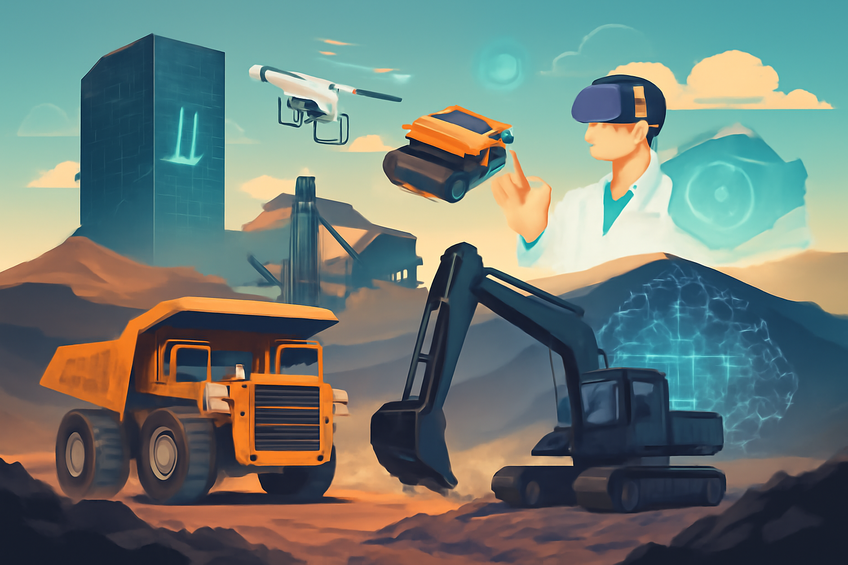
The mining industry is undergoing a radical transformation. As demand for critical minerals surges and environmental regulations tighten, companies worldwide are racing to adopt cutting-edge technologies that improve efficiency, safety, and sustainability. From autonomous machines to AI-powered exploration tools, breakthrough mining technologies in 2025 are redefining what’s possible beneath the earth’s surface.
Whether you’re an industry professional, investor, or technology enthusiast, understanding these innovations is crucial. Here’s a comprehensive look at the top 10 mining technologies reshaping the industry in 2025.
1. Autonomous Drilling and Blasting Systems
Autonomous drilling rigs have moved well beyond the experimental phase. In 2025, fully automated drilling and blasting systems are operational at major mine sites across Australia, Canada, and Chile. These systems use real-time geological data, GPS positioning, and machine learning algorithms to optimize drill patterns, reduce explosive waste, and minimize human exposure to hazardous zones.
Companies like Epiroc and Sandvik have deployed drill rigs capable of operating 24/7 without human intervention, delivering up to 35% improvement in drilling accuracy and significantly reducing operational costs.
2. Artificial Intelligence in Ore Body Modeling
AI and machine learning are transforming how geologists interpret subsurface data. Traditional ore body modeling required weeks of manual analysis. Today, AI-powered geological modeling platforms can process massive datasets from seismic surveys, drill core samples, and satellite imagery in a matter of hours.
Key Benefits of AI in Exploration
- Faster identification of high-grade ore zones
- Reduced exploration drilling costs by up to 40%
- More accurate reserve estimates
- Lower environmental footprint during exploration phases
Platforms like Seequent’s Leapfrog and AI startups such as KoBold Metals are leading the charge, helping companies discover deposits that would have previously gone undetected.
3. Battery Electric Vehicles (BEVs) in Underground Mining
Diesel-powered equipment has long dominated underground mining, contributing to poor air quality, high ventilation costs, and significant carbon emissions. In 2025, battery electric vehicles (BEVs) are rapidly replacing diesel fleets at underground mines worldwide.
Companies such as Boliden, Glencore, and Newmont have committed to full electric underground fleets. BEVs eliminate diesel particulate matter, reduce ventilation requirements by up to 50%, and lower total cost of ownership over the equipment lifecycle. The adoption of BEVs is not just an environmental decision — it’s a smart financial one.
4. Remote Operations Centers (ROCs)
Remote Operations Centers are centralizing mine management like never before. Using high-speed connectivity, real-time sensor networks, and advanced analytics dashboards, ROCs allow operators to control multiple mine sites from a single location thousands of kilometers away.
How ROCs Are Changing Mine Management
Rio Tinto’s Operations Centre in Perth, Australia, is a prime example — managing autonomous trucks, trains, and drills across its Pilbara iron ore operations in real time. ROCs enhance decision-making speed, reduce the need for on-site personnel in dangerous environments, and enable seamless coordination across entire mining ecosystems.
5. Drone Technology for Surveying and Inspections
Drones have become indispensable tools in modern mining operations. In 2025, LiDAR-equipped drones and thermal imaging UAVs are being used for topographic surveying, stockpile volume measurements, tailings dam monitoring, and equipment inspections.
What once took survey crews days to complete can now be accomplished in hours with millimeter-level accuracy. Drone inspections also remove workers from potentially dangerous environments such as unstable pit walls, high tailings storage facilities, and confined processing spaces.
- Stockpile measurements completed in under 2 hours
- Survey accuracy improved to within 2–3 centimeters
- Real-time hazard identification on pit walls
- Cost savings of up to 70% versus traditional survey methods
6. Advanced Sensor-Based Ore Sorting
One of the most impactful technologies in 2025 mining is sensor-based ore sorting (SBOS). Using X-ray transmission, laser-induced breakdown spectroscopy (LIBS), and near-infrared sensors, ore sorting systems can separate valuable ore from waste rock before it enters the processing plant.
This pre-concentration step dramatically reduces the volume of material processed, leading to lower energy consumption, reduced water usage, and higher overall plant efficiency. TOMRA and Steinert are among the global leaders deploying these systems at gold, copper, and diamond operations worldwide.
7. Digital Twins for Mine Planning and Optimization
A digital twin is a virtual replica of a physical mine — updated in real time using IoT sensors, operational data, and geological models. In 2025, digital twin technology is being used across the full mine lifecycle, from planning and design through to rehabilitation.
Applications of Digital Twins in Mining
Engineers can simulate different mining scenarios, test blasting designs, model equipment performance, and predict maintenance failures — all within a risk-free virtual environment. This capability reduces downtime, improves safety outcomes, and enables more precise short and long-term mine planning.
Hexagon Mining, Dassault Systèmes, and Bentley Systems are delivering robust digital twin platforms that integrate seamlessly with existing mine management software.
8. Hydrometallurgical and Bioleaching Innovations
As high-grade surface deposits become increasingly scarce, the industry is turning to advanced hydrometallurgical processing and bioleaching technologies to extract value from lower-grade ores and complex mineralogy.
Bioleaching uses microorganisms to oxidize sulfide minerals and release trapped metals — particularly copper, gold, and cobalt. New strains of bacteria engineered for higher temperature and acid tolerance are making bioleaching viable for a wider range of ore types, reducing the reliance on energy-intensive smelting and roasting processes.
These innovations are particularly important for the battery metals sector, where processing complex lithium, nickel, and cobalt ores efficiently is critical to meeting EV and energy storage demands.
9. Wearable Technology and Smart PPE
Worker safety remains the top priority in mining, and smart wearable technology is revolutionizing how mine sites manage health and safety in 2025. Devices embedded in helmets, vests, and boots now monitor vital signs, detect fatigue, measure gas exposure, and track worker locations in real time.
Features of Smart Mining PPE
- Real-time biometric monitoring (heart rate, body temperature)
- Proximity alerts near moving machinery
- Gas and dust exposure tracking
- Fatigue detection through eye movement and movement patterns
- Emergency SOS communication in no-network zones
Companies like Guardhat and Kinetic are providing integrated safety ecosystems that connect wearable data to central safety dashboards, enabling supervisors to act on potential incidents before they escalate.
10. In-Situ Leaching for Critical Minerals
In-situ leaching (ISL) — also known as solution mining — is gaining significant momentum as a low-impact extraction method for critical minerals including lithium, uranium, and copper. Rather than excavating rock, ISL involves injecting a leaching solution directly into the ore body underground, dissolving the target minerals, and pumping the mineral-rich solution to the surface for processing.
In 2025, advances in ISL chemistry and well-field design are expanding the range of deposits where this technique is viable. The environmental advantages are substantial — minimal surface disturbance, no tailings storage facilities, and dramatically lower energy consumption compared to conventional open-pit or underground mining.
As the global push for lithium accelerates to meet EV battery demand, ISL is emerging as a preferred extraction method for lithium-rich brine and clay deposits across South America, the United States, and Europe.
The Future of Mining Technology
The convergence of automation, artificial intelligence, electrification, and data analytics is creating a new era of mining that is safer, more productive, and more environmentally responsible than ever before. The technologies outlined above are not distant concepts — they are active deployments transforming real mine sites today.
For mining companies that embrace these innovations, the competitive advantages are clear: lower operating costs, improved safety records, reduced environmental liabilities, and the ability to extract value from deposits that were previously uneconomical.
As we move deeper into 2025 and beyond, the question is no longer whether mining technology will transform the industry — it’s whether companies will adopt these changes fast enough to remain competitive in a rapidly evolving global resources market.
Final Thoughts
The top 10 breakthrough mining technologies of 2025 represent more than incremental improvements — they signal a fundamental reimagining of how resources are discovered, extracted, and processed. From AI-powered exploration to in-situ leaching and fully autonomous operations, the mining industry is embracing the future with purpose and urgency.
Staying informed about these developments is essential for professionals, investors, and policymakers who want to understand the forces shaping global supply chains, energy transitions, and the broader economy for decades to come.


