





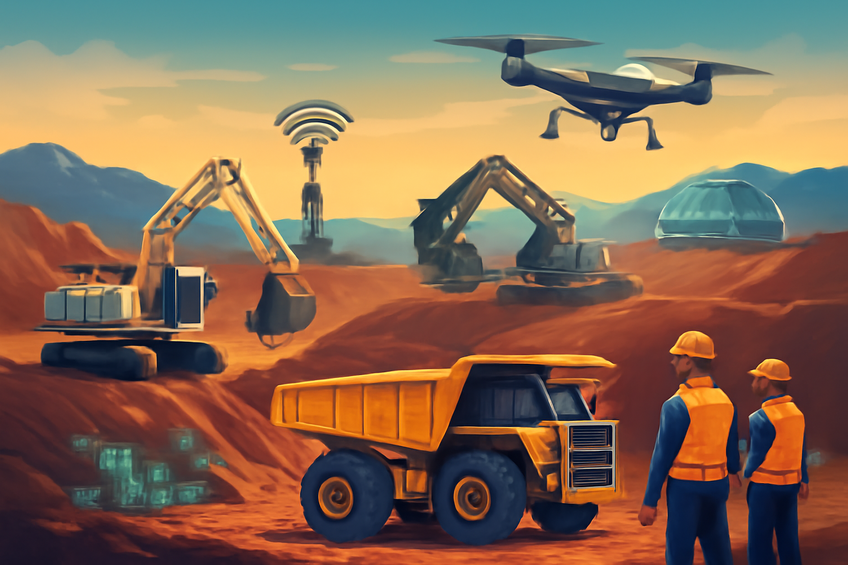
The mining industry is undergoing a massive transformation in 2025. With increasing pressure to improve safety, reduce environmental impact, and boost operational efficiency, mining companies worldwide are embracing cutting-edge technologies that are completely reshaping how resources are extracted. From autonomous vehicles to artificial intelligence, these innovations are setting new standards for the future of mining.
Why Technology Is Critical for the Future of Mining
The global demand for minerals, metals, and rare earth elements continues to surge due to the rapid growth of electric vehicles, renewable energy systems, and advanced electronics manufacturing. Traditional mining methods are no longer sufficient to meet these demands sustainably. That is why technology-driven mining solutions have become essential for companies looking to stay competitive while meeting environmental and safety regulations.
According to recent industry reports, the global mining technology market is expected to exceed $22 billion by 2027, reflecting the unprecedented level of investment flowing into digital transformation across the sector.
1. Autonomous Mining Vehicles and Equipment
One of the most visible technological revolutions in modern mining is the widespread adoption of autonomous haulage systems (AHS). Self-driving trucks, drills, and loaders are now operating in mines across Australia, Canada, Chile, and beyond, dramatically reducing human exposure to dangerous environments.
Key Benefits of Autonomous Mining Vehicles
- Reduced operator fatigue-related accidents by up to 80%
- Continuous 24/7 operation without shift changes
- Lower fuel consumption through optimized driving patterns
- Real-time data collection for predictive maintenance
Companies like Caterpillar, Komatsu, and Rio Tinto are already deploying fully autonomous fleets at scale, setting the benchmark for what the mining industry of the future will look like.
2. Artificial Intelligence and Machine Learning in Mining Operations
Artificial intelligence (AI) and machine learning (ML) are transforming every layer of mining operations, from exploration and drilling to processing and logistics. AI-powered systems can analyze massive geological datasets to identify the most promising ore deposits with far greater accuracy than traditional methods.
How AI Is Being Used in Mining Today
- Predictive maintenance to reduce equipment downtime by up to 50%
- Ore grade prediction to maximize extraction efficiency
- Automated fault detection in processing plants
- AI-driven scheduling for logistics and supply chain optimization
Machine learning algorithms process terabytes of sensor data in real time, enabling mine operators to make faster and more informed decisions that directly impact productivity and profitability.
3. Drone Technology for Mine Surveying and Monitoring
Unmanned aerial vehicles, commonly known as drones, have become indispensable tools in modern mining operations. These devices are being used for geological surveys, stockpile measurements, infrastructure inspections, and environmental monitoring with remarkable speed and precision.
Advantages of Using Drones in Mining
- Survey large areas in hours instead of days
- Generate highly accurate 3D topographic maps
- Eliminate the need for workers to enter hazardous zones
- Reduce surveying costs by up to 60% compared to traditional methods
LiDAR-equipped drones can now produce centimeter-level accuracy surveys, providing geologists and engineers with the precise data they need to plan and execute mining operations effectively.
4. Internet of Things (IoT) and Smart Sensor Networks
The Internet of Things (IoT) is connecting every piece of equipment, vehicle, and infrastructure component within modern mine sites into a single intelligent network. Thousands of smart sensors monitor everything from equipment temperature and vibration to air quality and structural integrity in real time.
This interconnected ecosystem allows mine managers to have a complete digital overview of their entire operation from a central control room, enabling them to identify issues before they escalate into costly failures or dangerous situations. The result is a smarter, safer, and more productive mining environment.
5. Advanced Robotics and Remote-Controlled Mining Systems
Robotic systems are increasingly being deployed in underground mining environments where conditions are too dangerous or physically challenging for human workers. Remote-controlled and semi-autonomous robots can drill, blast, and excavate with minimal human intervention.
Types of Robots Transforming Underground Mining
- Robotic drilling rigs with precision navigation systems
- Automated bolting machines for tunnel reinforcement
- Underground inspection robots for structural monitoring
- Explosive handling robots that eliminate human risk
The use of robotics not only protects human lives but also allows mining companies to access ore deposits in areas previously considered too dangerous or economically unviable.
6. Digital Twin Technology in Mine Planning
Digital twin technology is emerging as a game-changer in mine design, planning, and operational management. A digital twin is a real-time virtual replica of an entire mine operation that simulates physical processes, equipment behavior, and geological conditions with extraordinary accuracy.
By running simulations in the digital environment, mining engineers can test different extraction strategies, identify potential risks, and optimize workflows before implementing changes in the real world. This significantly reduces costly trial-and-error processes and helps companies achieve better outcomes with fewer resources.
7. Green Mining Technologies and Sustainable Energy Solutions
Environmental sustainability has become a top priority for the global mining industry, and green mining technologies are playing a central role in reducing the sector’s carbon footprint. In 2025, many leading mining companies have committed to achieving net-zero emissions, driving massive investment in clean energy solutions.
Sustainable Technologies Reshaping Mining
- Battery-electric and hydrogen-powered mining vehicles
- Solar and wind-powered mine site energy systems
- Waterless ore processing technologies
- Tailings management systems that minimize environmental impact
- Carbon capture and sequestration at processing facilities
Transitioning to renewable energy sources not only reduces emissions but also lowers long-term operating costs, making green mining a smart business decision in addition to an environmental imperative.
8. Blockchain Technology for Supply Chain Transparency
Blockchain technology is addressing one of the mining industry’s most persistent challenges — supply chain transparency and ethical sourcing. Consumers and regulators are increasingly demanding proof that minerals are extracted responsibly and without funding conflict or environmental destruction.
Blockchain-based tracking systems create an immutable digital record of every step in a mineral’s journey from the mine to the end product. This technology is already being used to certify conflict-free diamonds, ethically sourced cobalt, and responsibly mined gold, giving companies and consumers greater confidence in the origins of raw materials.
9. Advanced Data Analytics and Predictive Modeling
The modern mine generates enormous volumes of data every single day. Advanced data analytics platforms are helping mining companies turn this raw information into actionable insights that drive operational improvements across every department.
Applications of Data Analytics in Mining
- Real-time ore body modeling and reserve estimation
- Energy consumption optimization across processing plants
- Worker productivity tracking and safety monitoring
- Financial performance analysis and cost forecasting
With cloud computing and edge computing capabilities advancing rapidly, mining companies can now process and analyze data at unprecedented speeds, enabling truly data-driven decision making at every level of the organization.
10. Wearable Technology and Smart Safety Systems
Worker safety remains the highest priority in any mining operation, and wearable technology is taking occupational health and safety to a completely new level. Smart helmets, connected vests, and biometric monitoring devices are equipping miners with tools that can literally save their lives.
How Wearable Technology Is Protecting Miners
- Real-time location tracking to monitor worker positions underground
- Biometric sensors that detect fatigue, heat stress, and vital signs
- Augmented reality (AR) headsets for maintenance guidance and hazard alerts
- Gas detection wearables that warn of toxic atmosphere exposure
Integration with IoT platforms means that safety alerts from wearable devices can automatically trigger emergency protocols, notify supervisors, and even shut down nearby equipment when a worker is in danger.
The Challenges of Adopting New Mining Technologies
While the benefits of these technologies are clear, the path to digital transformation in mining is not without obstacles. Many companies face significant challenges including high implementation costs, cybersecurity risks, workforce skill gaps, and the need to integrate new systems with legacy infrastructure that may be decades old.
Successful technology adoption requires strong leadership commitment, comprehensive workforce training programs, and carefully managed change management strategies. Companies that invest in building a digitally skilled workforce will be far better positioned to capitalize on the full potential of these innovations.
The Future of Mining Technology Beyond 2025
Looking beyond 2025, the mining industry is poised for even more dramatic transformation. Quantum computing, advanced robotics, space mining concepts, and next-generation AI systems are all on the horizon, promising to further accelerate the pace of innovation in the sector.
Deep-sea mining technology is also advancing rapidly, opening up access to vast mineral deposits on the ocean floor that were previously considered inaccessible. While regulatory and environmental questions remain, this frontier represents potentially enormous resource reserves for future generations.
Conclusion
The future of mining in 2025 and beyond is undeniably technological. Companies that embrace autonomous systems, artificial intelligence, IoT networks, sustainable energy solutions, and data analytics will be the ones that define the next era of the global mining industry. These ten groundbreaking technologies are not simply trends — they are the foundations upon which the mines of tomorrow are already being built today.
For mining executives, investors, and industry professionals, the message is clear: digital transformation is no longer optional. The companies that act now to integrate these revolutionary technologies will secure their competitive advantage for decades to come, while those that delay risk being left behind in an industry that is changing faster than ever before.


