





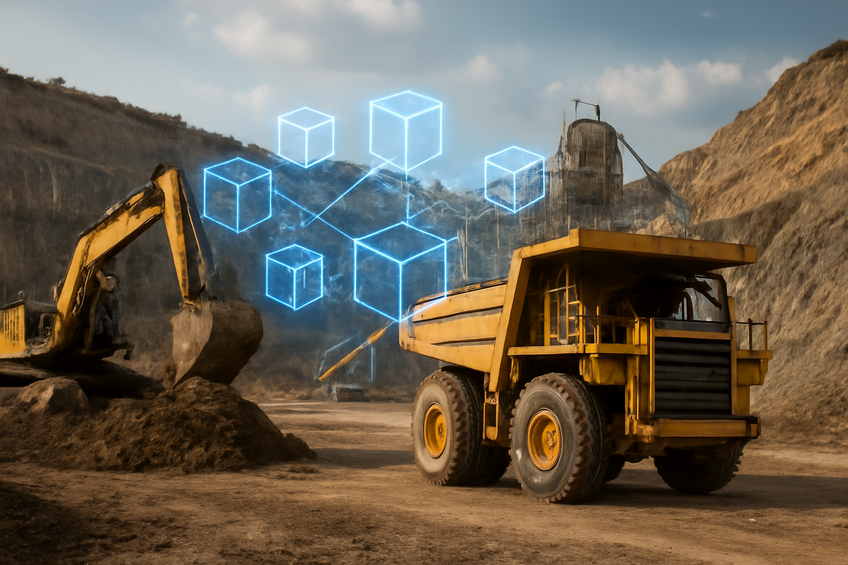
A New Layer of Accountability in Mineral Supply Chains
Blockchain traceability tools are moving from proof-of-concept pilots into active deployment across mineral supply chains, reshaping how companies approach responsible sourcing commitments. The technology’s core proposition — an immutable, distributed ledger that records each custody transfer from mine to market — directly addresses one of the extractive sector’s most persistent problems: the difficulty of verifying provenance claims without relying solely on paper documentation and third-party audits.
Interest has accelerated as downstream buyers in electronics, electric vehicles, and battery manufacturing face tightening regulatory requirements around supply chain due diligence. Legislation in major markets now demands documented evidence that minerals such as cobalt, tin, tantalum, tungsten, and lithium have not originated from conflict-affected or high-risk areas, or been produced using forced labour. Paper-based compliance systems are increasingly inadequate for that burden of proof.
What Blockchain Actually Offers Mining Companies
The technology’s appeal in a mining context rests on a handful of practical characteristics that conventional record-keeping cannot easily replicate. A distributed ledger shared across multiple parties — miners, traders, smelters, refiners, and manufacturers — reduces the ability of any single actor to alter or backdate records unilaterally. Each transaction or custody transfer is time-stamped and cryptographically linked to previous entries, creating an audit trail that is substantially harder to manipulate than siloed spreadsheets or PDF certificates.
Several platform developers have focused specifically on high-risk commodities, building systems that allow ore batches to be tagged at the point of extraction and tracked through successive processing stages. Some integrate QR codes, RFID tags, or isotopic fingerprinting alongside the ledger to provide a physical anchor for the digital record — an important safeguard against the most obvious weakness of any data system: garbage in, garbage out.
Key Capabilities Being Deployed
- Chain-of-custody recording: Documenting each transfer of material between parties with a timestamped, tamper-resistant entry.
- Supplier onboarding and credentialing: Storing audit results, certifications, and compliance documentation linked directly to specific mine sites or producers.
- Real-time visibility: Giving downstream buyers access to upstream data without requiring direct relationships with every tier of the supply chain.
- Smart contract automation: Triggering payments or alerts based on verified compliance milestones, reducing administrative friction.
- Integration with existing standards: Aligning ledger data with recognised frameworks such as the OECD Due Diligence Guidance and industry certification schemes.
The Limitations the Industry Cannot Afford to Ignore
Enthusiasm for blockchain in responsible sourcing circles has sometimes outpaced the technology’s actual capabilities, and a more sober assessment is taking hold. The fundamental limitation is that a blockchain records what participants enter into it — it cannot independently verify that a physical parcel of ore corresponds to a digital entry. Fraudulent inputs at the origin point remain a genuine risk, particularly in artisanal and small-scale mining contexts where formalisation is incomplete and governance is weak.
Interoperability is a related challenge. Multiple competing platforms have emerged, and supply chain actors who participate in more than one commercial ecosystem may be required to maintain parallel data systems. Without industry-wide standards for data formats and ledger architecture, fragmentation risks undermining the very transparency these tools are designed to deliver.
Cost and Capacity Barriers for Smaller Producers
Adoption costs — including hardware for on-site data capture, connectivity infrastructure, and training — can be prohibitive for artisanal miners and small-scale producers in remote jurisdictions. This creates a structural risk: traceability systems designed to protect vulnerable mining communities may in practice exclude them, concentrating verifiable supply among large, well-capitalised operations and pushing smaller producers further to the margins of formal markets.
Initiatives that pair blockchain deployment with broader formalisation support, financing, and capacity building are considered more likely to achieve meaningful traceability outcomes than technology rollouts pursued in isolation. The governance context matters as much as the platform architecture.
Regulatory Pressure Is Forcing the Pace
The responsible sourcing debate is no longer driven primarily by voluntary corporate commitments. Mandatory supply chain due diligence legislation across multiple major importing economies is creating binding obligations for companies to demonstrate — not merely assert — that their mineral inputs meet defined sourcing standards. Blockchain traceability platforms are being positioned as evidence infrastructure for precisely this kind of regulatory compliance.
Smelters and refiners occupy a critical chokepoint in this dynamic. As the stage at which diverse upstream sources are consolidated, they are increasingly the target of audits and disclosure requirements. Platforms that can aggregate upstream traceability data and present it in formats regulators and corporate compliance teams can readily verify are gaining traction at this tier of the supply chain.
Industry coalitions and certification bodies are beginning to explore how established audit and certification frameworks can be anchored to blockchain records rather than replaced by them — a hybrid approach that preserves institutional knowledge while improving the durability and accessibility of compliance data.
As regulatory requirements continue to tighten and downstream buyers demand higher evidentiary standards, blockchain traceability tools are likely to become standard infrastructure rather than a differentiating feature. The companies and platforms that succeed will be those that solve the governance and data-integrity problems sitting upstream of the technology itself — because a ledger is only as credible as the verification system behind it.


