





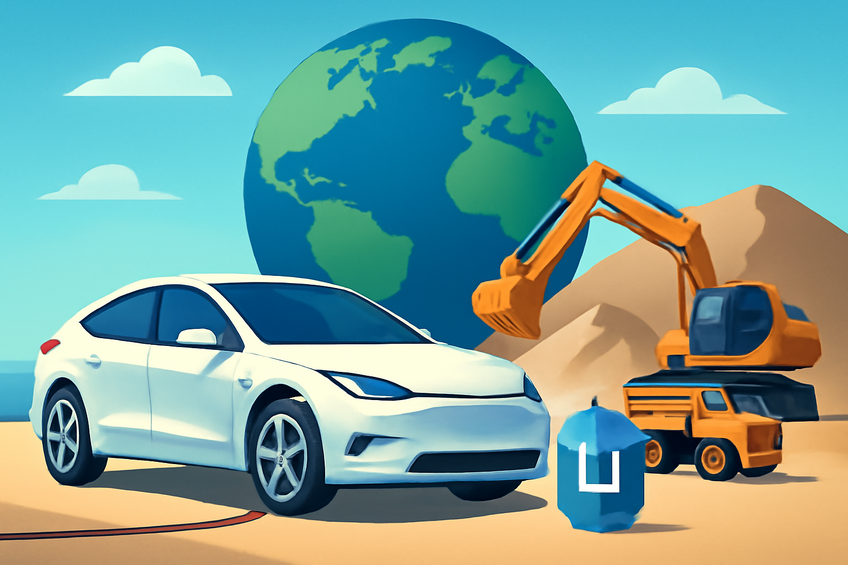
The global shift toward electric vehicles (EVs) has created an unprecedented demand for lithium — the critical mineral at the heart of every rechargeable battery. As automakers race to electrify their fleets and governments push ambitious green energy targets, lithium has become the new oil of the 21st century. Understanding which countries dominate lithium production is essential for investors, policymakers, and anyone following the clean energy transition. Here is a comprehensive look at the top 10 lithium mining countries powering the global electric vehicle revolution in 2025.
Why Lithium Is Critical for the Electric Vehicle Revolution
Lithium-ion batteries are the backbone of modern electric vehicles, storing the energy that powers motors and determines how far an EV can travel on a single charge. Without a stable and growing supply of lithium, the global transition to clean transportation simply cannot happen at the speed the world needs. In 2025, lithium demand has surged to record levels, driven by exponential EV adoption across Asia, Europe, and North America. Mining output, geopolitical stability, and technological advancements in extraction methods are now major factors shaping the future of the automotive industry.
The Global Lithium Market in 2025: Key Statistics
Global lithium production surpassed 180,000 metric tons of lithium carbonate equivalent (LCE) in 2025, a dramatic increase from just a few years ago. The International Energy Agency (IEA) projects that lithium demand could increase tenfold by 2040 if current EV adoption trends continue. The top producing nations collectively control over 95% of the world’s accessible lithium reserves, making geographic concentration a significant geopolitical concern for supply chain security.
Top 10 Lithium Mining Countries in 2025
1. Australia — The World’s Largest Lithium Producer
Australia continues to hold its position as the world’s number one lithium producer in 2025, contributing approximately 55% of global supply. The Pilbara region in Western Australia is home to the legendary Greenbushes mine, the largest and highest-grade hard-rock lithium operation on the planet. Australia primarily produces spodumene, a lithium-bearing mineral that is often exported to China for processing into battery-grade lithium chemicals. Major mining companies including Pilbara Minerals, Liontown Resources, and Albemarle’s Australian operations continue to expand capacity to meet soaring global demand.
2. Chile — The King of Lithium Brine Resources
Chile ranks as the second largest lithium producer globally and holds the world’s largest known lithium reserves, primarily concentrated in the Atacama Desert’s famous salt flats, known as the Salar de Atacama. Chilean production relies on brine extraction — a process where lithium-rich saltwater is pumped to the surface and evaporated in massive pools. Companies like SQM (Sociedad Química y Minera de Chile) and Albemarle operate large-scale facilities here. In 2025, Chile’s new national lithium strategy, which involves greater state participation through CODELCO, has reshaped the production landscape while aiming to maximize national economic benefit.
3. China — The Dominant Force in Lithium Processing and Mining
China is the third largest lithium producer by raw extraction, but it is unquestionably the most powerful player in the entire lithium value chain. Chinese companies control a massive share of global lithium refining and battery manufacturing capacity. Domestically, lithium is mined primarily from hard-rock spodumene deposits in Sichuan and Jiangxi provinces, as well as from brine deposits in the Qinghai-Tibet Plateau. Beyond domestic production, Chinese corporations have made strategic investments in lithium mines across Africa, South America, and Australia, giving China extraordinary influence over global lithium supply chains critical to the EV industry.
4. Argentina — Rising Star of the Lithium Triangle
Argentina forms the third corner of the famous Lithium Triangle alongside Chile and Bolivia, and the country has been aggressively expanding its lithium production in 2025. Argentina’s lithium-rich salt flats, particularly the Salar del Hombre Muerto, Salar de Olaroz, and Salar de Cauchari, are being developed by international mining companies including Lithium Americas, Allkem, and POSCO. The Argentine government has adopted a more investor-friendly approach compared to some neighbors, attracting billions in foreign direct investment. Production capacity in Argentina has grown significantly, with the country emerging as one of the most important future suppliers to global EV manufacturers.
5. Zimbabwe — Africa’s Lithium Powerhouse
Zimbabwe has emerged as one of the most significant lithium mining stories of the 2020s. The country possesses enormous hard-rock lithium reserves, particularly in the Bikita and Arcadia deposits, which are among the largest pegmatite lithium deposits in the world. In 2025, Zimbabwe’s ban on raw lithium ore exports — forcing processing to occur domestically — has attracted significant investment in local beneficiation facilities. Chinese investment has been particularly prominent, with companies like Zhejiang Huayou Cobalt and Sinomine Resource Group heavily involved in Zimbabwean lithium operations. Zimbabwe is now firmly established as Africa’s leading lithium producer.
6. Brazil — South America’s Emerging Lithium Giant
Brazil holds substantial lithium reserves, primarily in the state of Minas Gerais, where pegmatite deposits rich in spodumene and other lithium minerals are actively mined. In 2025, Brazil has accelerated its lithium development ambitions as part of a broader critical minerals strategy linked to its growing domestic EV and battery manufacturing sector. Companies like Sigma Lithium have brought major projects into production, producing high-purity lithium concentrate that attracts premium prices from global battery manufacturers. Brazil’s combination of large reserves, political stability relative to some competitors, and improving infrastructure makes it a key player to watch.
7. Portugal — Europe’s Leading Lithium Producer
Portugal holds the largest lithium reserves in Europe, concentrated primarily in northern regions such as Barroso and Guarda. In 2025, Portugal has dramatically expanded its lithium mining activity as the European Union pushes to reduce dependency on non-European lithium supplies under its Critical Raw Materials Act. The Barroso lithium project, developed by Savannah Resources, is one of the most significant new European mining ventures. Portugal’s lithium production directly supports Europe’s growing battery gigafactory ecosystem, helping major automakers like Volkswagen, BMW, and Stellantis build more secure and regionally diversified supply chains.
8. United States — Rebuilding Domestic Lithium Capacity
The United States has made dramatically increasing domestic lithium production a matter of national strategic priority in 2025. The Thacker Pass project in Nevada, operated by Lithium Americas, represents the largest known lithium resource in the United States and has moved into early production phases. Additionally, the Silver Peak mine in Nevada — operated by Albemarle — remains America’s only long-standing operational lithium mine. The Inflation Reduction Act continues to incentivize domestic critical mineral production, and several new projects across Nevada, North Carolina, and other states are advancing through permitting and development stages, aiming to reduce American dependence on foreign lithium sources.
9. Canada — A Stable and Growing Lithium Supplier
Canada has positioned itself as a reliable and ethically sourced lithium supplier to Western markets, an increasingly important distinction as automakers and governments prioritize supply chain transparency and environmental standards. Major projects in Ontario, Quebec, and the Northwest Territories are advancing rapidly. The Separation Rapids and Georgia Lake spodumene projects in Ontario, along with Quebec’s growing lithium sector supported by abundant clean hydroelectric power, make Canada an attractive destination for battery supply chain investment. Canada’s strong trade relationships with the United States and Europe, combined with its vast geological potential, ensure its growing relevance in global lithium markets.
10. Bolivia — The Sleeping Giant of Lithium
Bolivia holds what is estimated to be the single largest lithium deposit in the world — the Salar de Uyuni — with reserves potentially exceeding 21 million metric tons. Despite this extraordinary geological wealth, Bolivia has historically struggled to convert reserves into meaningful production due to political complexity, nationalization policies, and challenging brine chemistry that makes extraction more difficult than in neighboring Chile or Argentina. In 2025, Bolivia has made some progress through partnerships with Chinese and Russian companies, and small-scale industrial production has begun. However, Bolivia remains far below its potential, making it the most consequential “sleeping giant” in global lithium geopolitics, with the ability to reshape markets if extraction challenges and policy barriers are overcome.
The Lithium Triangle: A Geopolitical Powerhouse
Chile, Argentina, and Bolivia together form the famous Lithium Triangle, a geographic region that contains over 50% of the world’s known lithium reserves. The future of global EV battery supply chains is intimately tied to developments in this region. Political decisions, royalty regimes, water usage regulations, and indigenous community relations in these three countries have profound implications for lithium availability and pricing worldwide. In 2025, all three nations are navigating the complex challenge of maximizing economic benefit from their natural resources while managing environmental concerns and attracting the foreign investment needed to scale production.
Environmental Challenges Facing Global Lithium Mining
Despite its critical role in enabling clean transportation, lithium mining is not without significant environmental controversy. Brine extraction in arid regions like the Atacama Desert raises serious concerns about water consumption in already water-stressed ecosystems. Hard-rock mining operations generate large quantities of waste rock and can disturb sensitive habitats. In 2025, the industry is responding with innovations including direct lithium extraction (DLE) technology, which can recover lithium from brines with dramatically lower water usage and environmental footprint. Mining companies and governments are under increasing pressure from environmental groups, local communities, and ESG-conscious investors to demonstrate responsible and sustainable lithium production practices.
Direct Lithium Extraction: The Technology Changing the Industry
One of the most exciting developments in the lithium mining world in 2025 is the commercial scale-up of Direct Lithium Extraction (DLE) technology. Unlike traditional evaporation pond methods that can take 12 to 18 months and consume enormous amounts of water, DLE uses selective adsorption, ion exchange, or membrane-based processes to extract lithium from brine in hours. Several companies are deploying DLE commercially in Argentina, the United States, and elsewhere, with the technology promising higher lithium recovery rates, lower environmental impact, and the ability to access previously uneconomical lithium resources. DLE could significantly expand the global lithium supply base over the next decade.
Lithium Supply Chain Security: A Top Priority for Automakers
The concentration of lithium production and processing in a small number of countries — particularly China’s dominance in refining — has made supply chain diversification a top strategic priority for major automakers and battery manufacturers in 2025. Companies like Tesla, General Motors, Ford, Volkswagen, and Toyota are signing long-term offtake agreements directly with mining companies, investing in mining projects, and working with governments to develop alternative supply sources. The United States, European Union, and other major economies have introduced critical minerals strategies and trade agreements specifically designed to create more resilient lithium supply chains that reduce dependence on any single nation.
Lithium Recycling: Building a Circular Economy
As the first generation of lithium-ion EV batteries reaches end-of-life, battery recycling is emerging as an increasingly important supplementary source of lithium. Companies like Li-Cycle, Redwood Materials, and Umicore are scaling up battery recycling capacity in North America and Europe, recovering lithium, cobalt, nickel, and other valuable materials from used batteries. While recycled lithium currently represents a small fraction of total supply, analysts project that by the mid-2030s, recycled material could supply a meaningful percentage of lithium demand, reducing pressure on primary mining operations and improving the overall sustainability profile of the EV industry.
Investment Opportunities in Lithium Mining Countries
For investors seeking exposure to the lithium megatrend, the top lithium mining countries offer a range of opportunities across the risk-reward spectrum. Australian producers like Pilbara Minerals and Liontown Resources offer exposure to established hard-rock mining operations. Chilean giants SQM and Albemarle provide large-cap, dividend-paying options. Junior explorers in Argentina, Canada, and Zimbabwe offer higher risk but potentially higher reward opportunities for those willing to accept exploration and development risk. Lithium-focused ETFs such as the Global X Lithium & Battery Tech ETF (LIT) provide diversified exposure across the entire supply chain from mining to battery manufacturing.
Future Outlook: Which Countries Will Lead Lithium Production Beyond 2025?
Looking beyond 2025, the lithium production landscape is expected to continue evolving rapidly. Argentina is projected to grow production most dramatically as multiple large projects come online. Zimbabwe will expand if infrastructure and investment challenges are managed successfully. Bolivia has enormous long-term potential if political and technical barriers are overcome. Meanwhile, new lithium frontiers including geothermal brines in Germany, lithium-rich clay deposits in the United States, and potential deep-sea nodule resources may add new dimensions to global supply. Emerging technologies like sodium-ion batteries and solid-state batteries could also eventually reduce lithium intensity per vehicle, though lithium is expected to remain dominant in EV batteries throughout the 2020s and well into the 2030s.
Conclusion: Lithium Mining Countries Are Shaping the EV Future
The top 10 lithium mining countries — Australia, Chile, China, Argentina, Zimbabwe, Brazil, Portugal, the United States, Canada, and Bolivia — are not simply producing a commodity. They are powering a fundamental transformation in how the world moves, generating energy, and addressing the climate crisis. The decisions made by governments, mining companies, and investors in these nations over the next decade will determine whether the global electric vehicle revolution achieves its full potential. For anyone tracking the future of energy, transportation, and geopolitics, keeping a close eye on the world’s lithium mining landscape is absolutely essential.


