





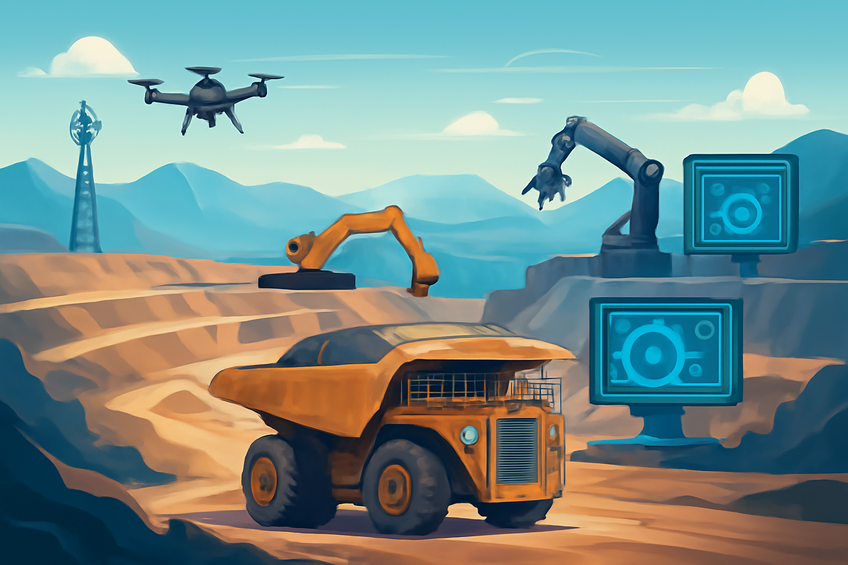
The mining industry has always been at the forefront of adopting innovative solutions to improve efficiency, safety, and sustainability. As we move through 2025, a new wave of technological advancements is completely transforming how mining companies operate around the globe. From artificial intelligence to autonomous machinery, these groundbreaking technologies are not only making mining more productive but also significantly reducing its environmental footprint. In this comprehensive guide, we explore the top 10 technologies that are revolutionizing the modern mining industry today.
1. Autonomous Mining Equipment and Robotics
One of the most significant shifts in the mining industry is the widespread adoption of autonomous vehicles and robotic systems. Self-driving haul trucks, automated drilling rigs, and robotic loaders are now operating in mines across Australia, Canada, Chile, and beyond. These machines work around the clock without fatigue, dramatically increasing productivity while reducing the risk of human injury in dangerous underground and surface mining environments.
Companies like Caterpillar, Komatsu, and Rio Tinto have invested billions into autonomous fleet management systems that use GPS, LiDAR, and real-time data analytics to navigate complex mining terrains with precision. In 2025, the autonomous mining equipment market is projected to exceed $5 billion, highlighting just how critical this technology has become to modern operations.
2. Artificial Intelligence and Machine Learning in Mining Operations
Artificial intelligence (AI) and machine learning (ML) are reshaping every aspect of mining, from exploration and extraction to processing and logistics. AI-powered algorithms can analyze massive geological datasets to identify mineral deposits with greater accuracy than traditional methods, significantly reducing exploration costs and time.
Predictive Maintenance Powered by AI
One of the most impactful applications of AI in mining is predictive maintenance. By continuously monitoring equipment performance through sensors and IoT devices, AI systems can predict mechanical failures before they occur. This proactive approach helps mining companies avoid costly downtime, extend equipment lifespan, and save millions in unexpected repair costs annually.
AI-Driven Ore Grade Prediction
Advanced machine learning models are now being used to predict ore grades in real time, allowing processing plants to optimize their operations dynamically. This results in higher metal recovery rates, reduced energy consumption, and minimized waste production — all critical factors for sustainable mining in 2025.
3. Internet of Things (IoT) and Smart Mine Technology
The concept of the “smart mine” has moved from theory to reality, thanks to the rapid expansion of Internet of Things (IoT) technology. Modern mining operations now deploy thousands of connected sensors across equipment, infrastructure, and personnel to collect and transmit real-time data. This interconnected network enables mine managers to monitor everything from air quality and structural integrity to equipment performance and worker location simultaneously.
IoT platforms integrate seamlessly with cloud computing solutions, giving mining companies centralized dashboards that provide complete operational visibility. The result is faster decision-making, improved safety protocols, and significantly enhanced operational efficiency that would have been impossible just a decade ago.
4. Drone Technology and Aerial Surveying
Unmanned aerial vehicles (UAVs), commonly known as drones, have become indispensable tools in the modern mining industry. In 2025, mining companies are using drones for a wide range of applications including topographic surveying, stockpile volume measurement, environmental monitoring, and infrastructure inspection.
Advanced drones equipped with LiDAR sensors, thermal cameras, and multispectral imaging can survey vast mining areas in a fraction of the time it would take traditional ground crews, delivering highly accurate 3D maps and volumetric data. This not only reduces operational costs but also improves safety by eliminating the need for personnel to access hazardous areas for inspection purposes.
5. Digital Twin Technology
Digital twin technology is rapidly gaining traction in the mining sector as a powerful tool for planning, optimization, and risk management. A digital twin is a virtual replica of a physical mining operation that mirrors real-world conditions in real time. By simulating different scenarios and testing operational changes in the virtual environment, mining engineers can identify potential issues and optimize processes without disrupting actual production.
Leading mining companies are using digital twins to model entire mine sites, processing facilities, and supply chains. This technology helps in reducing operational risks, lowering energy consumption, improving resource allocation, and ultimately driving greater profitability. As computing power continues to increase, digital twins are becoming even more sophisticated and valuable in 2025.
6. Advanced Robotics for Underground Mining
Underground mining presents some of the most challenging and dangerous conditions in any industry. Advanced robotics are now being deployed to handle the most hazardous tasks deep within the earth, keeping human workers out of harm’s way. Remote-controlled robotic systems can perform drilling, blasting, ore loading, and tunnel inspection in environments that would be unsafe for human operators.
Exoskeleton Technology for Mining Workers
Beyond traditional robotics, wearable exoskeleton suits are being introduced to assist underground workers in physically demanding tasks. These powered exoskeletons reduce the physical strain on workers, decrease the likelihood of musculoskeletal injuries, and enable workers to handle heavier loads with greater ease, improving both safety and productivity simultaneously.
7. Green Mining Technologies and Sustainable Energy Solutions
Environmental sustainability has become a top priority for mining companies worldwide, driven by stricter regulations, investor pressure, and a global push toward net-zero emissions. In 2025, green mining technologies are at the center of this transformation. Mining operations are increasingly powered by renewable energy sources such as solar, wind, and hydrogen fuel cells, significantly reducing their carbon footprint.
Electric and hydrogen-powered mining vehicles are replacing diesel-powered equipment, eliminating harmful emissions in underground environments and lowering operational energy costs. Companies are also investing in water recycling systems, tailings management technologies, and biodiversity restoration programs as part of their commitment to responsible mining practices.
Hydrogen-Powered Mining Haul Trucks
Hydrogen fuel cell technology is emerging as a game-changer for heavy mining vehicles. Several major mining companies have already begun trialing hydrogen-powered haul trucks that produce zero direct emissions and offer performance comparable to their diesel counterparts. As hydrogen production costs continue to decline, widespread adoption across the industry is expected within the next few years.
8. Blockchain Technology for Supply Chain Transparency
Blockchain technology is making a significant impact on mining supply chains by providing an immutable, transparent ledger for tracking minerals from the point of extraction to the end consumer. This is particularly important for conflict mineral compliance, ethical sourcing verification, and regulatory reporting requirements that have become increasingly stringent globally.
By using blockchain, mining companies can demonstrate the provenance of their products with unprecedented accuracy, building trust with customers, investors, and regulators alike. In sectors like cobalt, diamonds, and rare earth elements, blockchain-based traceability systems are becoming a standard expectation rather than a competitive advantage in 2025.
9. Advanced Data Analytics and Big Data in Mining
The mining industry generates enormous volumes of data every single day, from geological surveys and equipment sensors to production records and market data. Advanced big data analytics platforms are enabling mining companies to extract meaningful insights from this data at scale, leading to smarter decision-making across every level of the organization.
Real-time analytics dashboards give operations teams instant visibility into production performance, helping them quickly identify bottlenecks and inefficiencies. Meanwhile, advanced statistical models help geologists and engineers make better decisions about where to mine, how to mine, and when to make critical investments in infrastructure and equipment. In a highly competitive global market, data-driven decision-making is becoming a key differentiator for successful mining companies.
10. Augmented Reality (AR) and Virtual Reality (VR) Training Solutions
Augmented reality and virtual reality technologies are transforming how mining companies train their workforce and maintain their operations. VR-based training simulations allow new employees to learn complex and dangerous procedures in a completely safe virtual environment before setting foot in an actual mine. This significantly reduces training time, improves knowledge retention, and most importantly, prevents accidents caused by inexperienced workers.
AR technology is being used by maintenance teams to overlay digital information onto physical equipment, guiding technicians through complex repair procedures step by step with hands-free instructions. This reduces errors, speeds up maintenance processes, and helps companies address the growing skills shortage in the mining sector by enabling less experienced workers to perform tasks that previously required years of expertise.
The Future of Mining Technology: What Lies Ahead
The technological revolution in mining shows no signs of slowing down. As we look beyond 2025, emerging technologies such as quantum computing, advanced nanotechnology, and next-generation battery storage systems promise to further transform the industry in ways we are only beginning to imagine. Mining companies that embrace these innovations today will be best positioned to thrive in an increasingly competitive and environmentally conscious global market.
The integration of these ten groundbreaking technologies is not just about improving profitability — it represents a fundamental shift toward a safer, more sustainable, and more efficient mining industry that can meet the growing demand for critical minerals while minimizing its impact on the planet. For mining companies, technology adoption is no longer optional; it is an absolute strategic imperative for long-term success in 2025 and beyond.
Conclusion
From autonomous vehicles and artificial intelligence to blockchain and green energy solutions, the modern mining industry in 2025 is being completely transformed by technology. These ten groundbreaking innovations are helping mining companies operate more safely, efficiently, and sustainably than ever before. As global demand for minerals continues to grow — particularly for those essential to the clean energy transition — embracing these technologies will be crucial for any mining operation looking to stay competitive and responsible in the years ahead. The future of mining is digital, autonomous, and sustainable, and that future is already here.


