





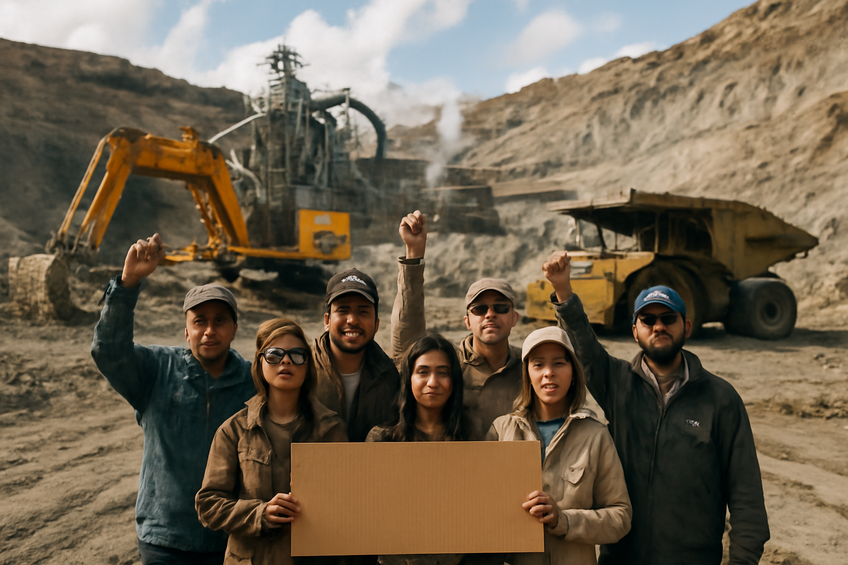
Competing Claims Over Ground: A Pattern Repeating Across Mining Jurisdictions
Tensions between artisanal and small-scale mining (ASM) communities and large-scale industrial operators are intensifying across multiple continents, as concession expansions by major mining companies increasingly overlap with land that informal miners have worked for generations. The conflict is not new, but its frequency and visibility have grown considerably as rising commodity prices make previously marginal ground commercially attractive to industrial players.
In West Africa, Central Africa, South America, and parts of Southeast Asia, the same dynamic plays out with striking regularity: a junior or major mining company receives a government-granted concession that encompasses territory where ASM operators already live and work. What follows — displacement, negotiation, confrontation, or some combination — depends heavily on local governance frameworks, the strength of community organization, and the degree of political will to enforce protections for informal miners.
Why ASM Communities Are Mobilizing More Effectively
Artisanal mining communities have historically operated at a significant disadvantage in disputes with industrial operators. Limited legal standing, lack of formal documentation, and scarce access to legal counsel have made it difficult to mount sustained challenges. That picture is shifting, driven by several converging factors.
Access to Legal Frameworks and Advocacy Networks
International human rights frameworks, including the United Nations Guiding Principles on Business and Human Rights, have given advocacy organizations and affected communities clearer language and legal footing to challenge forced displacement. NGOs specializing in land rights and extractive industry accountability have become more sophisticated in advising ASM communities on documentation, formal complaints, and engagement with government licensing bodies.
In a growing number of cases, communities have successfully petitioned national mining ministries to pause or review concession applications before operations begin, introducing a procedural friction that did not exist a decade ago.
Advertisement
Mobile Technology and Cross-Border Solidarity
Smartphones and social media have changed the organizing capacity of remote communities in ways that industry and governments are still adjusting to. Video evidence of bulldozed settlements, water source contamination, or security force activity can reach international audiences within hours, creating reputational pressure on listed companies sensitive to investor scrutiny on environmental, social, and governance grounds.
Cross-border networks of ASM communities facing similar pressures now share strategies, legal templates, and media contacts, reducing the isolation that made earlier disputes easier for industrial operators to manage quietly.
The Industrial Operator Perspective
Mining companies seeking to expand concessions are not operating in a vacuum. National governments grant licenses under their sovereign authority over subsoil resources, and operators argue — with legal justification in most jurisdictions — that formal concession rights take precedence over informal land use. Many also point to investment in community development programs, local hiring commitments, and revenue-sharing agreements as evidence of good-faith engagement.
The practical reality, however, is that these commitments frequently fail to address the core grievance: the loss of livelihood for miners whose only viable economic activity is working the same ground the industrial operator intends to exploit at scale. Compensation packages calibrated to resettlement costs rarely account for the multi-generational economic and cultural significance of ASM territories.
The Cost of Getting It Wrong
Project delays caused by community opposition carry measurable financial consequences. Prolonged disputes can affect permitting timelines, trigger enhanced due diligence requirements from lenders and institutional investors, and in some cases prompt government reviews of concession terms. Companies with material conflicts in their social license disclosures face increased scrutiny from ESG-focused fund managers who have become a significant capital source for the sector.
Advertisement
- Project delays arising from blockades, legal challenges, or government intervention can extend development timelines by months or years.
- Reputational exposure from documented conflict can affect relationships with offtake partners and development finance institutions.
- Regulatory risk increases when high-profile disputes attract parliamentary or ministerial attention in host countries.
- Insurance and financing costs may rise when social risk assessments flag unresolved community conflict.
- Secondary market scrutiny intensifies as responsible sourcing standards become procurement requirements for downstream buyers in electronics, jewelry, and battery supply chains.
Toward Coexistence or Continued Conflict?
Some jurisdictions have attempted to formalize co-existence frameworks that carve out designated ASM zones within larger concession areas, allowing artisanal operators to continue working lower-grade or geologically complex sections of ground while industrial operations proceed elsewhere. Results have been mixed. Where such arrangements are designed with genuine community input and enforced by credible regulatory bodies, they have reduced friction. Where they are imposed as a procedural formality, they tend to generate further grievance.
Formalization of ASM — bringing informal miners into regulated frameworks with legal title, access to equipment finance, and environmental compliance support — is widely cited as the structural solution. Progress remains slow, undercut by bureaucratic barriers, corruption, and the economic precarity of miners who cannot afford the costs and delays of formal licensing processes.
The trajectory of these disputes will be shaped in large part by whether governments treat ASM communities as a governance problem to be managed or as legitimate economic stakeholders whose interests merit structural protection. As commodity demand continues to draw industrial capital into territories with active artisanal mining histories, the pressure to find durable answers — not short-term accommodations — will only increase.
Advertisement


