




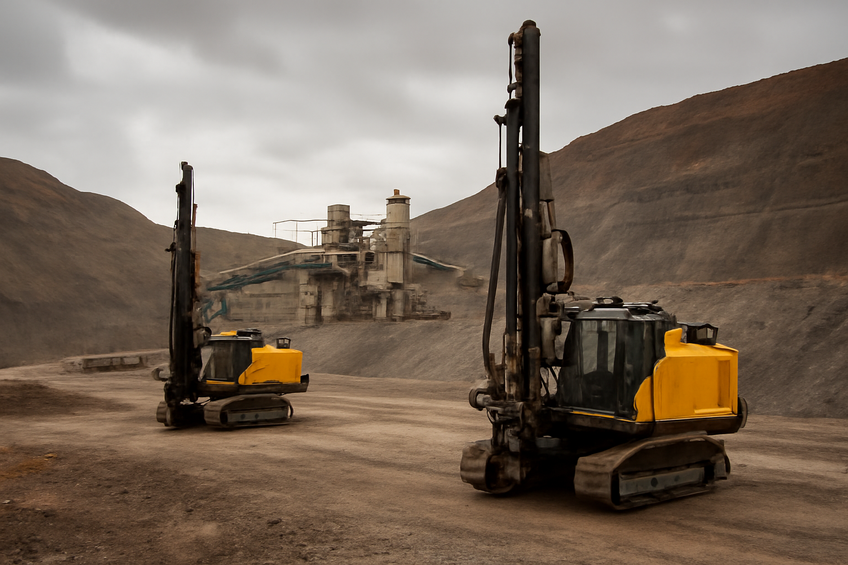
Autonomous drill rigs are completing one of mining’s most significant operational transitions, moving out of controlled pilot environments and into full-scale production deployment across surface and underground operations worldwide. What began as cautious experimentation at select mine sites has matured into a commercially viable technology that major and mid-tier miners are now rolling out as standard fleet components rather than novelties.
The Shift From Proof-of-Concept to Production Reality
The gap between piloting a technology and deploying it at scale is where most mining innovations stall. Autonomous drilling has largely closed that gap, driven by a combination of hardware reliability improvements, more robust collision avoidance systems, and software platforms capable of integrating with existing fleet management infrastructure. Early pilots often ran single autonomous rigs alongside conventional crews in isolated zones; today’s deployments increasingly involve entire drill fleets operating autonomously across full bench patterns.
The economics have sharpened the business case considerably. Autonomous rigs consistently deliver higher utilization rates than manually operated equivalents, primarily by eliminating shift-change downtime, operator fatigue effects, and the variability inherent in human-controlled penetration rates. Drilling consistency also translates downstream — tighter hole placement and depth accuracy improve blast fragmentation, which carries efficiency gains into loading, hauling, and crushing circuits.
What Changed to Enable Full Deployment
Several converging developments pushed autonomous drilling past the pilot threshold:
- Sensor maturity: LiDAR, radar, and high-definition cameras have become reliable enough for continuous open-pit and underground environments, where dust, vibration, and variable lighting previously degraded performance.
- Connectivity infrastructure: Widespread adoption of private LTE and 5G networks at mine sites has resolved latency and bandwidth issues that once limited real-time telemetry and remote supervision capability.
- OEM integration: Major drill manufacturers have embedded autonomy packages as factory-fitted options rather than third-party retrofits, reducing integration risk and maintenance complexity.
- Regulatory clarity: Several mining jurisdictions have developed clearer frameworks for autonomous equipment operation, reducing approval uncertainty for site operators.
- Workforce adaptation: Training programs have produced a generation of drill technicians comfortable supervising multiple autonomous units remotely from operations centers, fundamentally reshaping crew structures.
Operational Impacts Across the Mine Cycle
The effects of full autonomous drill deployment extend well beyond the drill bench itself. When rigs execute patterns with high geometric precision, blast engineers gain confidence to design tighter, more optimized patterns. The result is more predictable muck pile profiles, better dig rates for electric shovels and hydraulic excavators, and reduced secondary blasting requirements. These downstream benefits are increasingly factored into the financial justification for autonomy programs, moving the conversation beyond simple drill-meter-per-hour comparisons.
Advertisement
Safety Performance
Removing personnel from the immediate drill zone addresses one of the more persistent risk categories in open-cut mining. Drill rigs operate in proximity to unstable highwalls, beneath flyrock exposure zones, and alongside heavy haulage traffic — conditions that carry inherent injury potential. Autonomous systems don’t eliminate all hazard from the drill bench, but they substantially reduce the consequence of equipment incidents by keeping workers at a distance. Early data from sites with mature autonomous programs suggests measurable reductions in drill-related recordable injuries, though operational context varies significantly between sites.
Underground Applications Gaining Momentum
Surface mining led autonomous drilling adoption, but underground applications are accelerating. Development drilling and production ring drilling in hard-rock underground mines present a compelling autonomy case — confined headings, repetitive patterns, and difficult ventilation conditions all favor removing operators from the immediate work area. Tele-remote operation, where a single operator supervises rigs from surface, is now transitioning toward higher autonomy levels in underground settings as navigation and positioning systems improve in GPS-denied environments.
Challenges That Remain
Full deployment does not mean frictionless deployment. Several operational realities continue to test autonomous drilling programs at scale:
- Ground condition variability: Autonomous control systems perform well in homogeneous ground but require increasingly sophisticated adaptive algorithms to handle geological transitions, fractured zones, and unexpected voids without human intervention.
- Maintenance skill gaps: The electronic and software complexity of autonomous rigs demands maintenance technicians with different skill sets than traditional mechanical driller roles, and that talent pool is still developing across the industry.
- Interoperability: Sites running mixed fleets from multiple OEMs face integration challenges when attempting to coordinate autonomous drills with other autonomous or semi-autonomous equipment under a unified management platform.
- Change management: Labor relations and workforce transition remain sensitive at many operations, particularly in jurisdictions where mining employment carries significant community and policy weight.
Where the Technology Heads Next
Autonomous drilling is increasingly being positioned as a data source as much as an operational tool. Rigs equipped with measurement-while-drilling sensors capture real-time geomechanical data — penetration rate, torque, rotation pressure — that feeds directly into geological models and mine planning systems. The convergence of autonomous operation with continuous orebody sensing creates the foundation for adaptive, closed-loop mine planning that adjusts drilling patterns dynamically as ground conditions are better understood.
As confidence in autonomous drill performance grows and the technology becomes embedded in standard operating procedures, the industry’s attention is shifting toward optimizing the human supervisory role and extracting maximum value from the data these systems generate. The transition from pilot to deployment, once the central challenge, is giving way to a more demanding question: how to integrate autonomous drilling into a fully connected, data-driven mine operation.
Advertisement


