





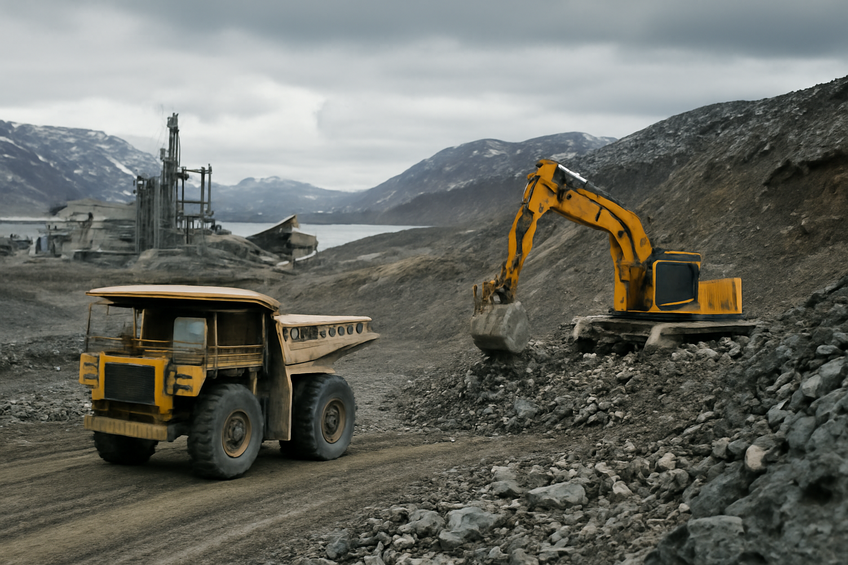
Greenland’s vast and largely untapped mineral endowment has moved from geological curiosity to serious geopolitical flashpoint, drawing the attention of governments, mining majors, and junior explorers alike. As competition for critical minerals intensifies across the Arctic, Greenland increasingly occupies a central role in discussions about supply chain security, rare earth independence, and the strategic balance between Western nations and their rivals.
A Geological Prize in a Contested Region
The island’s bedrock hosts one of the world’s most diverse concentrations of critical minerals, including rare earth elements, lithium, cobalt, nickel, copper, and uranium. These are precisely the materials that underpin batteries, defence electronics, wind turbines, and semiconductor supply chains — sectors where Western governments have identified dangerous dependencies on a narrow set of producing nations.
Greenland’s geological formations, exposed by millennia of glacial erosion, offer unusually high-grade deposits in some cases. The Kvanefjeld complex in the south, for example, has long been recognised as one of the largest rare earth projects outside of China, though it remains entangled in permitting debate and domestic political opposition to uranium co-extraction. The broader mineral belt across southern and western Greenland is considered highly prospective, with systematic exploration still in early stages across vast swathes of territory.
Why Now? The Timing of Arctic Ambition
Several converging pressures explain why Greenland’s mineral potential has become an urgent policy priority rather than a long-term aspiration. Western nations have accelerated domestic critical mineral strategies in response to supply concentration risks, and Greenland — as an autonomous territory within the Kingdom of Denmark — sits squarely within the political and regulatory orbit of allied democracies. That matters enormously for governments seeking to diversify supply chains without relying on jurisdictions perceived as strategically hostile.
Climate change is also a practical factor. Receding ice cover has improved access to previously unreachable terrain, extended the operational season for exploration, and opened new shipping routes that reduce logistical costs. What was once a prohibitively expensive proposition is becoming progressively more viable.
Advertisement
The Arctic Rivalry Dimension
Greenland does not exist in a geopolitical vacuum. Russia maintains a substantial Arctic military and resource presence across its northern territories, while China has pursued investment and influence in Arctic infrastructure and research programmes. Both nations have signalled long-term strategic interest in Arctic access, resources, and sea routes — making Greenland’s alignment with Western partners a matter of significance well beyond commercial mining.
The United States has been particularly direct about its interest in Greenland, reflecting broader Indo-Pacific and Arctic strategy. American officials have repeatedly emphasised Greenland’s importance to North Atlantic defence architecture as well as its mineral potential. European governments, led by Denmark, have responded by deepening investment frameworks and trade partnerships with Nuuk designed to demonstrate that Greenland’s future prosperity lies within the Western alliance rather than through alternative arrangements.
China’s Rare Earth Leverage and the Greenland Response
China currently dominates the global rare earth supply chain at multiple stages, from mining through processing and finished magnets. This concentration has prompted consuming nations to accelerate alternative sourcing strategies, and Greenland is frequently cited as a credible source of diversification. Any significant rare earth project reaching production in Greenland would represent a structural shift in the supply equation, reducing the leverage that rare earth export controls or pricing pressure can exert on Western manufacturers.
Greenland’s Own Calculus: Sovereignty, Revenue, and Public Opinion
Greenland is not simply a passive object of great power competition. The island’s government — the Naalakkersuisut — holds authority over subsoil resources and has pursued an active, if cautious, approach to licensing and investment attraction. Mining revenues represent one of the few realistic pathways toward the fiscal self-sufficiency that many Greenlanders associate with eventual independence from Denmark.
However, the domestic political environment is complex. Key segments of the population and political establishment hold strong reservations about large-scale industrial development, particularly where uranium extraction is involved, and about the environmental impact on fragile Arctic ecosystems. Any government seeking to advance mining activity must navigate:
Advertisement
- Uranium policy: The question of whether to permit uranium as a co-product of rare earth extraction remains deeply contested and has stalled major projects.
- Environmental standards: Greenlandic authorities have made clear that international best-practice environmental frameworks are a prerequisite for permitting.
- Community consent: Indigenous Greenlandic communities expect meaningful consultation and demonstrable local benefit from any large-scale project.
- Foreign ownership limits: There is ongoing scrutiny of investment from certain non-allied jurisdictions, with pressure to favour partners from NATO countries.
Infrastructure as the Persistent Bottleneck
Even where geology is favourable and permits achievable, Greenland’s infrastructure deficit remains a formidable constraint. The island lacks roads connecting its settlements, has limited port capacity capable of handling bulk concentrate shipments, and operates on expensive imported energy. Capital costs for new projects are therefore substantially higher than comparable developments in more accessible jurisdictions, requiring either sovereign support, concessional finance, or exceptionally high-grade ore bodies to generate acceptable returns.
Exploration Activity and Investment Trends
Despite the challenges, exploration activity across Greenland has grown steadily, with junior companies and larger explorers holding licence positions across multiple commodity types. Interest has been particularly strong in rare earths, base metals, and battery materials. Allied government programmes — including export finance facilities and strategic mineral partnerships — have begun directing capital toward pre-feasibility and feasibility work in a way that was largely absent a decade ago.
As geopolitical competition for critical mineral supply chains shows no sign of easing, Greenland’s combination of geological richness, allied-jurisdiction status, and improving Arctic access is likely to draw intensifying attention from both capital markets and governments. The island’s ability to convert that attention into productive, socially supported, and environmentally sound mining development will determine whether it becomes a genuine pillar of Western mineral strategy or remains a tantalising prospect that perpetually falls short of its promise.
Advertisement


