




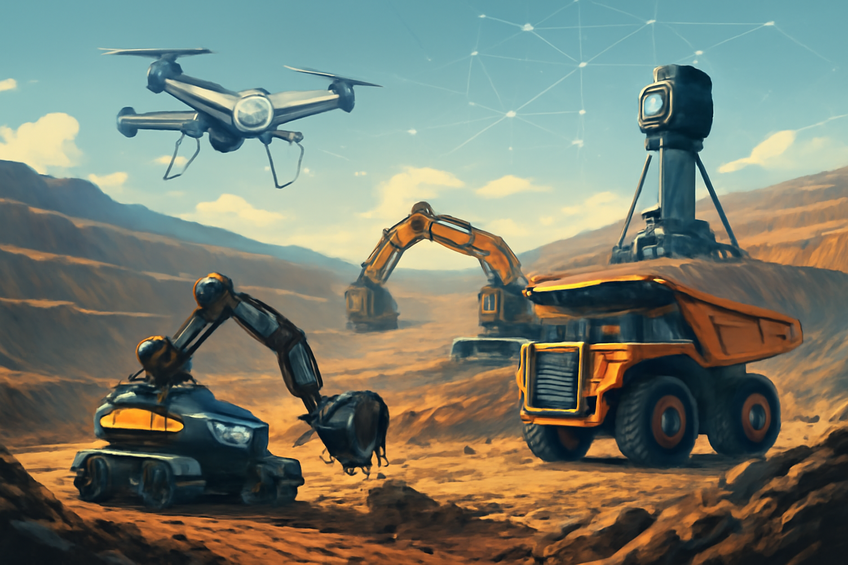
The mining industry has always been at the forefront of adopting cutting-edge innovations to improve efficiency, safety, and sustainability. As we step into 2025, a new wave of revolutionary technologies is completely reshaping how minerals and resources are extracted from the earth. From autonomous machinery to artificial intelligence, these advancements are not just improving productivity — they are redefining the entire future of mining. Let’s explore the top 10 technologies transforming the mining industry in 2025.
1. Autonomous Mining Vehicles and Equipment
One of the most significant breakthroughs in modern mining is the widespread adoption of autonomous vehicles and equipment. Self-driving haul trucks, autonomous drilling rigs, and remotely operated loaders are now operating in mines around the world with minimal human intervention. Companies like Caterpillar and Komatsu have deployed fully autonomous fleets that operate 24/7, reducing operational costs by up to 30% while significantly improving worker safety by keeping humans away from hazardous environments.
These vehicles use advanced sensors, GPS technology, and machine learning algorithms to navigate complex mine terrains, avoid obstacles, and optimize haulage routes in real time.
2. Artificial Intelligence and Machine Learning in Mining Operations
Artificial Intelligence (AI) and Machine Learning (ML) are playing a transformative role in modern mining. AI-powered systems are being used for predictive maintenance, geological data analysis, ore grade prediction, and operational optimization. By analyzing massive datasets collected from sensors and machinery, AI can predict equipment failures before they occur, saving millions in downtime costs.
Machine learning models are also helping geologists identify high-probability mineral deposits faster and more accurately than traditional methods, reducing exploration costs and timelines significantly.
Advertisement
Key Applications of AI in Mining
- Predictive maintenance of heavy machinery
- Real-time ore body modeling
- Automated geological surveys
- Energy consumption optimization
- Safety risk assessment and management
3. Internet of Things (IoT) and Smart Sensors
The Internet of Things (IoT) has introduced a new era of connected mining. Smart sensors embedded in equipment, infrastructure, and even workers’ gear collect real-time data across every aspect of mining operations. This continuous stream of data enables mine managers to monitor equipment health, track worker locations, measure air quality, and detect structural instabilities instantly.
IoT-connected systems create a fully integrated digital ecosystem where every machine, vehicle, and worker is part of a unified network. This not only boosts productivity but also dramatically enhances safety protocols across underground and surface mines.
4. Drone Technology for Surveying and Monitoring
Drones and Unmanned Aerial Vehicles (UAVs) have become indispensable tools in the modern mining toolkit. In 2025, drones are being used extensively for topographic surveys, stockpile measurement, environmental monitoring, and infrastructure inspection. What once took teams of surveyors days or weeks to complete can now be done in hours with high-precision aerial drones.
LiDAR-equipped drones can generate detailed 3D maps of mine sites, providing engineers with accurate data for planning and decision-making. Underground drones are also emerging as critical tools for inspecting areas too dangerous for human access.
5. Blockchain Technology for Supply Chain Transparency
The mining industry has long faced challenges related to supply chain transparency, ethical sourcing, and regulatory compliance. Blockchain technology is addressing these challenges head-on by creating immutable, transparent records of every transaction and movement in the mineral supply chain.
Advertisement
From the moment ore is extracted to when it reaches the end consumer, blockchain ensures full traceability. This is particularly important for conflict minerals like cobalt, gold, and diamonds, where ethical sourcing has become a major concern for global corporations and consumers alike. In 2025, blockchain-based platforms are becoming standard practice among major mining corporations and their supply chain partners.
6. Advanced Robotics and Remote Operations Centers
Robotics technology in mining has evolved far beyond simple automation. In 2025, advanced robotic systems are capable of performing complex tasks such as underground drilling, explosive loading, and precision cutting with remarkable accuracy. These robots can operate in environments that are too hot, toxic, or unstable for human workers.
Complementing robotics are state-of-the-art Remote Operations Centers (ROCs), where highly skilled operators control entire mining operations from thousands of kilometers away. This model not only improves worker safety but also attracts new talent to the industry by offering modern, technology-driven work environments.
7. Green Mining Technologies and Renewable Energy Integration
Sustainability has become a non-negotiable priority for the global mining industry. Green mining technologies are being rapidly adopted to reduce the environmental footprint of extraction activities. In 2025, many mines are transitioning to renewable energy sources such as solar, wind, and hydrogen to power their operations.
Electric mining equipment is replacing diesel-powered machinery, significantly cutting greenhouse gas emissions and improving air quality in underground mines. Water recycling systems, tailings management innovations, and eco-friendly blasting techniques are further minimizing environmental impact and helping mining companies meet strict global sustainability targets.
Advertisement
Environmental Benefits of Green Mining Technologies
- Significant reduction in carbon emissions
- Lower water consumption through advanced recycling
- Reduced noise and air pollution
- Improved land rehabilitation post-mining
- Compliance with international environmental standards
8. Digital Twin Technology
Digital twin technology is revolutionizing mine planning and operational management. A digital twin is a virtual replica of a physical mine that simulates real-world conditions using live data feeds. Engineers and managers can use digital twins to test different scenarios, optimize production plans, simulate equipment behavior, and identify potential risks — all without disrupting actual operations.
In 2025, digital twins are being used across the entire mine lifecycle, from exploration and design to operation and closure. This technology enables faster decision-making, reduces costly trial-and-error processes, and ultimately extends the productive life of mining assets.
9. Advanced Data Analytics and Big Data
The modern mine generates an enormous volume of data every single day. Big data analytics platforms are helping mining companies make sense of this information to drive better business and operational decisions. By integrating data from geological surveys, production systems, weather conditions, and financial metrics, advanced analytics tools provide actionable insights that improve efficiency and profitability.
Real-time dashboards and predictive analytics enable mine managers to identify bottlenecks, forecast production outputs, and allocate resources more effectively. In 2025, data-driven decision-making is no longer a competitive advantage — it is an operational necessity.
10. 5G Connectivity and Edge Computing
The rollout of 5G networks in mining environments is enabling faster, more reliable communication between connected devices, vehicles, and control systems. With ultra-low latency and high bandwidth, 5G supports the simultaneous operation of hundreds of autonomous machines and IoT devices in real time — something that previous network generations simply could not handle.
Advertisement
Paired with edge computing, which processes data closer to the source rather than sending it to distant cloud servers, 5G is transforming the responsiveness and reliability of mining operations. This combination is critical for real-time safety monitoring, autonomous vehicle coordination, and instant data processing in remote mine locations.
The Future of Mining Is Now
The convergence of these ten revolutionary technologies is creating a mining industry that is safer, more efficient, more sustainable, and more profitable than ever before. As we progress through 2025 and beyond, mining companies that embrace these innovations will be best positioned to meet growing global demand for critical minerals while reducing their environmental and social impacts.
From AI-driven exploration to green energy-powered operations and blockchain-secured supply chains, the future of mining is being built today. Companies, investors, and policymakers who recognize and support these technological shifts will play a defining role in shaping a more responsible and resilient global mining industry for generations to come.
Advertisement


